This Season
 

How to Identify Maryland Spiders

How to Identify Maryland Spidersthumbnail
Triangulate Cobweb Spider

There are many different types of spiders living in the southern regions of the United States, and some are even native to Maryland. Some of them are poisonous, some of them are harmless, and some of them help to keep the number of insect pests living around our houses low. However, if you get a visit from one of these eight-legged guardians, it is important to know how to identify different types of spiders so that you can tell which ones are dangerous and which ones can be calmly moved outside.

Related Searches:
    Difficulty:
    Moderately Easy

    Instructions

      • 1

        Judge how large the spider is by looking at the length of its body and the length of its legs.

      • 2

        Check to see if the spider has a body that is 1 inch or more in length without including the leg span. If it does, then the spider is most likely a wolf spider or a fishing spider. If the spider has a body that is less than 1 inch long without including the leg span, then you skip to Step 5.

      • 3

        Determine if it is a wolf spider. This type will have a leg span of about 2 inches. It is brown with a dark gray-black cross pattern on its back, and it is very furry and bulky looking. Wolf spiders are rarely found indoors, only mildly venomous, and their bites will usually only cause itching.

      • 4

        Estimate how long the spider's leg span is. If the leg span is around 3 inches, and the spider is a dark brown color with light and dark gray markings, then it could be a fishing spider. These spiders enjoy living near water and dark, damp places. They can run across water to hunt for prey. They do not maintain a web, and they are just poisonous enough to cause minor redness and necrosis near their bites.

      • 5

        Do not attempt to measure the leg span of smaller spiders. It is much easier to tell these spiders apart by looking for distinct traits or markings. In Maryland, these spiders could be yellow house spiders, brown recluse spiders, black widows, flower spiders, bold jumping spiders, cellar spiders or cobweb spiders.

      • 6

        Look for a yellow-green color on the spider's body and a darker color on its legs. If this coloration is present and the spider is about 1/4 inch long, then it is probably a yellow house spider. These spiders cannot puncture the skin of all people, and even if they do, they are only mildly venomous.

      • 7

        Check to see if the spider is brown and smooth with a violin-shaped pattern on its back. If it fits this description, then the spider is most likely a brown recluse spider. These spiders are very poisonous, aggressive, and they enjoy hiding in soft places like the arms and legs of clothing, bedding, or pillows more than any other spider in Maryland.

      • 8

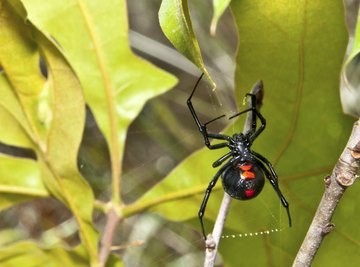
        Look at the coloration of the spider and see if it is black with a red hourglass-shaped pattern on its underbelly. If it is, then it is almost certainly a black widow. These spiders have extremely poisonous venom, and commonly hang upside down from their rough, messy webs.

      • 9

        Check to see if the spider is brightly colored and found amongst a cluster of flowers. If it is, the spider is most likely a flower spider. These spiders are a type of crab spider, and they will wait for unsuspecting bees or butterflies to come land near the clusters of flowers. Flower spiders are not dangerous to humans.

      • 10

        Look carefully at the spider to see if it is black with a white marking on its back. Also, if the spider is jumping around, this is another big sign that the spider you are looking at is a bold jumping spider. These spiders are aggressive and spunky, with a bite that hurts, but lacks any dangerous poison.

      • 11

        Look to see if the spider has a very small body with relatively long legs. If the spider fits this description, and was found in a dark, damp place, then it is most likely a cellar spider. These spiders cannot penetrate human skin.

      • 12

        Check the spider in question to see if it is brown with triangle-shaped tan markings on its back. If it is, then this spider is most likely a triangulate cobweb spider. These spiders are not dangerous to humans, but they do hunt brown recluse spiders and black widows.

    Tips & Warnings

    • Spider identification is tricky business if you squish your eight-legged visitor. Avoid pounding a spider to death if you would like to know what it is.

    • If none of these steps led you to an identification of the spider in question, send a picture to a biologist in the area, or contact a poison control center if bitten.

    • Always seek medical attention if bitten by a poisonous spider. Serious symptoms may not start appearing for as long as 8 hours after the initial bite. If you can, try to catch the spider that bit you so that you can present it to medical officials for identification.

    Related Searches

    Resources

    Read Next:

    Comments

    You May Also Like

    • Common Maryland Spiders

      Common Maryland Spiders. Maryland has a healthy population of spiders within its borders. All of these species subsist on insects and other...

    • How to Identify a Brown Recluse Spider

      Brown recluse spider bites are not pleasant. Many harmless brown spiders are often mistaken for the brown recluse. Here is how to...

    • Poisonous Spiders in China

      Poisonous Spiders in China. According to the Chinese Spider Database, there are 3,416 species of spiders in China today. Of these, only...

    • Spiders That Live in Maryland

      Several species of spiders exist throughout Maryland. While spiders have fangs, most species lack fangs capable of penetrating human skin. Those that...

    • Spiders Found in Maryland

      Spiders play a vital role in the control of insects, and can be found in every region of the United States. However,...

    • List of Birds From Maryland

      Maryland is home to the Chesapeake Bay and Cunningham Falls State Park, which are habitats for many of the state's birds. The...

    • Signs & Symptoms of Black Widow Spider Bite

      Most black widow spiders live in the western and southern United States. When the female black widow spider bites, she emits a...

    • Comparison of Brown Recluse & Wolf Spiders

      The bite of the brown recluse spider can cause serious health problems, including death, especially in children, the elderly and people in...

    • Types of House Spiders

      There are approximately 2,500 different types of spiders in North America. Most spiders are not house dwellers, instead preferring an outdoor habitat....

    • Spider Mites on Yew Bushes

      Spider mites are small creatures which feed on trees and plants. Spider mites look green when they are young, later becoming a...

    • Spiders in the Eastern U.S.

      Spiders are members of the Araneae order. Some of these eight-legged creatures capture their prey in their webs, while other spiders ambush...

    • Brown Spiders That Are Native to Michigan

      Spiders are eight-legged creatures that can sometimes be poisonous to humans. A brown-colored spider in Michigan can be anything from a dangerous...

    • Spiders Common to Florida

      Florida, also know as the Sunshine State, is home to over 750 species of spiders. Many of the spiders found in Florida...

    • Brown Spiders Found in Michigan

      Brown Spiders Found in Michigan. Even though popular imagination lumps spiders together with other bugs, they're arachnids, related to mites, ticks and...

    • How to Identify Spiders Living in a Garage

      Identifying a spider that is present in a garage can sometimes be a scary task, especially if that spider has bitten someone....

    • How to Compare the Brown Recluse & the Black Widow Spider Bites

      All spiders contain venom. Few species have the potential for being dangerous to humans. Brown recluse bites are quite painful and in...

    • Signs & Symptoms of Brown Recluse Spider Bites

      The brown recluse spider is native to the southern-central regions of the United States. The brown recluse, or violin spider, is named...

    • Poisonous Spiders of New Jersey

      Poisonous Spiders in New Jersey. Part of the charm of New Jersey (also known as the Garden State) is the variety of...

    Follow eHow

    Related Ads