
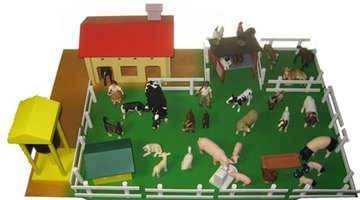

The montessori farm set is used many places in the learning curriculum. This farm set contains plastic figures of objects and animals commonly found on a farm. Generally, these objects are relatively straightforward to read and spell, although they can contain phonograms. The farm also comes with a series of cards with the names of the objects on them. These cards are usually black with white writing. To do this lesson, a child will already need to be able to read the words on the cards.
Have the child line up the farm objects in any order he likes. They can be lined up horizontally with lots of space in between or in several rows. There needs to be enough room in between the rows to fit the cards in below the objects.
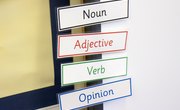
Place the heading cards from each box at the top of the table. Your noun cards will be in a box with the heading card reading "noun" and the adjective cards will be in a box along with a heading card reading "adjective." These cards should be placed at the top of the work area next to each other where the child can see them. The noun heading should be to the left of the adjective heading because the adjective describes the noun.
Assign the noun cards to each object. For example, a plastic pen will have the card with the word "pen" on it beside or under it, while a pig will have a card bearing the word "pig."
Start describing the figurines. Use the adjective cards to select accurate words to describe them. As you select descriptions, add these cards to the left of the noun cards but to the write of the articles. For example, ask the child what word describes the pig. If they select "pink," then insert the pink card in between "the" and "pig." The result will read, "the pink pig." The student may want to use more than one adjective. This is fine.
Repeat the lesson on subsequent days. You can use harder words as the student becomes more comfortable with reading and spelling the words. You can also allow him to work independently on the lesson if he desires.
Tip
This lesson can be used over and over to demonstrate that adjectives can be used in many different arrangements with different words and that the same adjective can be used to describe different objects.
Related Articles





Tips
- This lesson can be used over and over to demonstrate that adjectives can be used in many different arrangements with different words and that the same adjective can be used to describe different objects.