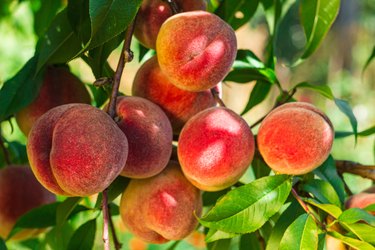
Peaches (Prunus persica) are widely grown in Texas, although the varying climate from the Gulf Coast and south Texas to the continental weather of north Texas affects which varieties are appropriate. There are numerous cultivars that are good for growing in various parts of the state.
Sun and Soil Requirements
Video of the Day
Peaches grow in U.S. Department of Agriculture plant hardiness zones 4 through 8, but most varieties do especially well in zones 7 and 8. They need lots of sun and well-drained soil. The best soil is 18- to 24-inch-deep sandy loam on top of well-draining red clay. Blue, gray, or mottled clay typically drains poorly. Peaches grow poorly in salty soil. A soil pH between 6.5 and 7 is ideal.
Video of the Day
Winter Chilling Requirements
To break winter dormancy and grow and bloom normally in spring, peaches need a minimum number of winter hours below 45 degrees Fahrenheit. These hours, known as the chilling requirement, vary among peach cultivars. If a tree's chilling requirement is too low, frost may destroy early blooms. If the requirement is too high, a tree may be slow to break dormancy, resulting in low peach yields. The chilling requirement varies among different parts of Texas.
Roughly speaking, the chilling requirement for peaches grown in north Texas, including the Dallas-Fort Worth area, is 900 to 1,000 hours. Going south, the requirement drops to 800, to 700, and then to 600 hours at the latitude of Austin in central Texas and to 400 hours in San Antonio and along the Gulf Coast, including Houston. It drops to 200 hours in McAllen and the southern tip of Texas.
Popular Peach Cultivars in Texas
Peaches are classified as clings if the flesh clings to the pit and freestones if it does not. Here is a sampling of some cultivars and their chilling requirements:
- Flordaprince (Prunus persica 'Flordaprince'), a small cling, 100 hours.
- EarliGrande (Prunus persica 'EarliGrande'), a small to medium semicling, 200 hours.
- Rio Grande (Prunus persica 'Rio Grande'), a large freestone, 450 hours.
- Tex Royal (Prunus persica 'Tex Royal'), a large freestone, 600 hours.
- Bicentennial (Prunus persica 'Bicentennial'), a small cling, 700 hours.
- Fireprince (Prunus persica 'Fireprince'), a large freestone, 800 hours.
- Surecrop (Prunus persica 'Surecrop'), a medium cling, 1,000 hours.
Watering Texas Peaches
Experts recommend drip irrigation for peach trees. If you have access to sufficient water, give your new peach tree (per week):
- 7 gallons of water per week in April and May.
- 14 gallons in June.
- 28 gallons in July and August.
- 21 gallons in September. You may not have to water in autumn if seasonal rains arrive.
Give second-year trees (per week):
- 14 gallons of water in April and May.
- 28 gallons in June.
- 56 gallons in July and August.
- 28 gallons in September (if autumn rains have not arrived).
Water mature, peach-bearing trees based on class A pan evaporation data. Design irrigation systems to provide at least 50 gallons of water per day to each tree.
Fertilizing Texas Peach Trees
Give a young peach tree 1 pound of 10-10-10 fertilizer roughly six weeks after you plant it. Scatter the fertilizer 18 inches from the trunk and water well. Apply 3/4 pound of 10-10-10 fertilizer in the spring and the early summer of the second year. Beginning the third year, apply 1 pound of nitrogen each year in early spring when the tree starts to grow.
The first number in a fertilizer ratio gives the amount of nitrogen by weight. A 10-pound bag of 10-10-10 fertilizer would yield 1 pound of nitrogen. Avoid fertilizing within two months of the first expected autumn frost.