
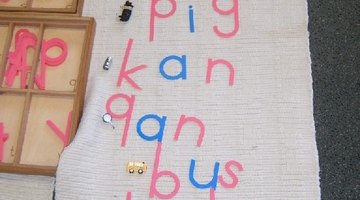

In Montessori schooling, spelling does not receive a high priority because Montessori experts believe that constant correction of spelling errors at an early stage in the child's learning experience can make them hesitant and even reluctant to engage in the learning process. However, you can help your child learn spelling as they practice word building and reading by using Montessori lessons that focus on phonetic reading.
Select several object boxes. These boxes should contain objects that have simple names that can be sounded out, such as "pig" or "man."
Place the objects in a line on the green mat. The large movable alphabet should also be close at hand.
Have the child build the name of the first object beside the object. For example, if you have a pig, then you will need to sound out the name to determine the letters in the word. You might first say, "Pig," then draw it out to "Puh, Ih, Guh." When the word is stretched out, the child can select the letters that match the sound. Generally, the child should not be asked to read the word he has just built, as most Montessori experts believe that reading and word building should remain separate until later in the learning process.
Work through the rest of the objects. You can build a lot of words or just five or six, depending on the child's comfort level and enthusiasm for the project. The important thing is that she is associating sounds with letters. Remember, do not correct spelling mistakes at this time. The more often the child does the exercise, the fewer mistakes she will make.
Keep the lesson in an easily accessible location. The child should be encouraged to build words every day. He can use familiar words or try new ones, but you should discreetly monitor his progress so that if there is a major and repetitive problem with the association between letters and sounds you can gently correct it.
Tip
Some elementary montessori school teachers do give spelling tests. If your school does not do so, work with your child's instructor if you want to help them with spelling at home. Many children actually enjoy spelling tests as long as they are given the opportunity to correct and repair work, so work with your child's teacher to decide how to best complement their in-school learning.
Tip
This exercise can also be done with picture cards instead of object boxes.
Related Articles







Tips
- Some elementary montessori school teachers do give spelling tests. If your school does not do so, work with your child's instructor if you want to help them with spelling at home. Many children actually enjoy spelling tests as long as they are given the opportunity to correct and repair work, so work with your child's teacher to decide how to best complement their in-school learning.
- This exercise can also be done with picture cards instead of object boxes.
Writer Bio
This article was written by the CareerTrend team, copy edited and fact checked through a multi-point auditing system, in efforts to ensure our readers only receive the best information. To submit your questions or ideas, or to simply learn more about CareerTrend, contact us [here](http://careertrend.com/about-us).