Like all animals that specialize in a particular habitat, aquatic frogs have been endowed by nature with certain characteristics that enable them to survive where other less adapted species might not. However, being so exclusively adapted for an aquatic environment makes frogs dependent upon that habitat for survival. Habitat loss in the form of shrinking wetlands has a drastic impact on frog populations and puts many species at risk.
Fancy Feet
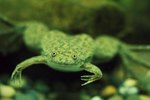
The longer legs of aquatic frogs, coupled with the extensive webbing between their toes, give these water-lovers a real swimming advantage, just as swimming flippers designed to mimic the frog foot help humans swim better. The increased surface area of the webbed toes offers resistance to water and allows them to push it behind them, propelling them forward more effectively than non-webbed feet could do.
Sensitive Skin
Frog skin is highly adapted for water—it's the original wetsuit, really. Since frogs do not swallow water, but absorb it through the skin, and because they must also absorb much of their oxygen through skin as well, having a ready source of water for soaking is a must. The delicacy of frog skin also makes it vulnerable to drying from sun and heat, so frogs exude a mucus covering to keep it moist and undamaged. That “slimy” feel humans often associate with frogs is the protective mucus coating. To ensure the skin stays nice and soft, frogs replenish it once a week by pulling the old skin off over their heads like a piece of clothing—revealing fresh new skin beneath.
The Eyes Have It
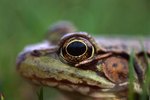
A frog’s eyes are useful tools. Because they are large and rounded, they allow the frog to look in all directions without moving his body, making it hard to sneak up on him and giving him a distinct advantage over potential prey. Frog eyes are especially adapted to seeing in dim conditions, which makes these already useful attributes even more important underwater, where conditions are often murky. Another interesting adaptation of a frog’s eyes is their location. Perched on the top of his head, the large eyes act as periscopes for observing predators and prey even as he happily soaks his skin below the water’s surface.
Fun Frog Facts
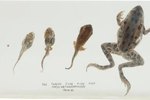
Of all the North American aquatic frogs, the bullfrog (Rana catesbeiana) is the largest. The tadpoles of this species can reach 4 to 6 inches in length.
Many terrestrial frogs get around the need for water—so important to their aquatic brethren—by making a hardened cocoon around their bodies from the mucus that protects their sensitive skin. This allows some frogs to live even in hot, dry desert regions.
References
- South Dakota Department of Game, Fish and Parks, Division of Wildlife: Northern Leopard Frog: Rana pipiens
- Cornell University Entomology Department: Life Under Water [PDF]
- Exploratorium: The Amazing, Adaptable Frog
- Fairfax County Public Schools: Bullfrog (Rana catesbeiana)
- Cornell Center for Material Research: Archives of Ask a Scientist
Resources
Photo Credits
-
John Foxx/Stockbyte/Getty Images