The field of physical science includes astronomy, chemistry, geology, meteorology and physics. Students love physical science experiments because they can be flashy enough to wow even the most jaded classmate or adult. Some of the most visually interesting experiments are simple to do and require only the most basic materials.
The Magnificent Egg Drop
Getting a hard-boiled egg to drop into the mouth of a bottle is a classic experiment. Everyone wants to duplicate the trick and know how it was done. This experiment teaches students about how differing air pressures work.
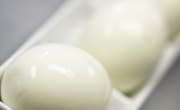
Materials include: a hard-boiled egg, a bottle with a mouth slightly smaller than the egg, a 3-inch square piece of newspaper and a match. The egg has to be peeled.
Show the students that the egg cannot fit into the bottle. Fold the newspaper into a strip, light it and drop it into the bottle. When the egg is put back on the top of the bottle, it falls into the bottle. Sometimes the egg breaks into pieces because it's too large. This can be fixed by using a smaller egg or by putting some oil on the mouth of the bottle. The egg slides into the bottle because of a difference in the air pressure inside and outside the bottle. At the start of the experiment, the air pressure inside and outside the bottle was the same. When the burning paper was put in the bottle, the air heated up and expanded. When the egg was put back on the bottle, it extinguished the fire, and the air cooled. The cooling air contracted making the pressure inside less than the pressure outside. The higher pressure outside pushed the egg into the bottle.
Create a Tornado
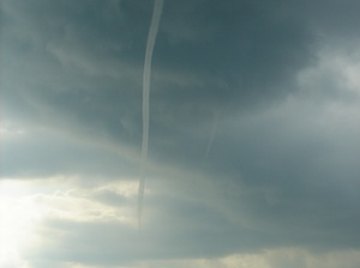
Tornadoes are windstorms that whirl around the center at more than 200 miles per hour. A tornado has a rotating funnel cloud coming out of dark clouds. Some funnels reach the earth and others do not. The ones that reach the earth create massive amounts of damage. A tornado that does touchdown may retreat upwards into the black clouds and then drop down again.
Kids can create their own tornadoes at home with a few simple materials including: a glass jar that is filled about 3/4 full with water, some food coloring and a teaspoon of dishwashing detergent.
Put the lid on the jar and shake for about 20 seconds. The liquid forms a funnel that looks like a real tornado and behaves similarly.
Sink or Swim
Science experiments are a great way for kids to impress their friends and parents by explaining an everyday event in scientific terms. Everyone is familiar with opening up a cooler at a picnic and finding some cans at the bottom and some floating on the top. Who knows why?
Materials for this experiment include: three unopened cans of regular soda (of any brand), three unopened cans of diet soda and an aquarium or a large cooler filled with water.
Students will be trying to see which cans float and which cans sink. They should place one can of regular soda in the water first to see if it sinks or floats, and then try a can of diet soda. They should repeat this until they use all the cans. Which ones sink and which ones float? They need to explain why because this is where they can show off their scientific knowledge.
First, the cans have the same size and volume. The density of the cans is different because of the substance dissolved in the soda: sugar. The regular soda has sugar dissolved in it for sweetening. The diet soda uses artificial sweeteners which are much sweeter than sugar so there is less of it in the soda. This difference accounts for the difference in density. The more dense regular soda sinks, and the less dense diet soda floats.
About the Author
Bruce Pohlmann is an international educator, author and anthropologist. Pohlmann began writing about Southeast Asia and education in 1980. He has written many articles for both print and digital magazines, websites and blogs, including "Kabar Magazine," Escape Artist, and Offshore Wave. He holds a Ph.D. in anthropology from the University of California, Berkeley.
Photo Credits
Twister image by Isa from Fotolia.com