
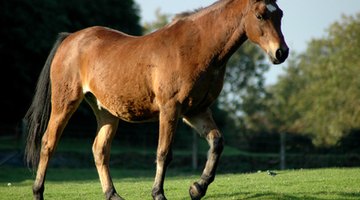


Equine veterinary medicine is a challenging and competitive field. Finding a job in this specialty is made easier by attending a top school. There are a number of schools that offer a top-rate education in equine veterinary medicine. These schools have challenging curriculum, state-of-the-art facilities and experienced faculty.
Cornell University
Located in Ithaca, New York, Cornell University's College of Veterinary Medicine is widely renowned as a top graduate program for aspiring veterinarians. Ranked as U.S. News and World Report's top overall school for veterinary medicine, Cornell has one of the best equine veterinary programs. Cornell College of Veterinary Medicine is home to the Equine Performance Testing Clinic, where students can get hands-on experience treating horses and researching equine athletic health. Admission into Cornell College of Veterinary Medicine is highly competitive. The cost of attendance for the 2009-2010 school year was $20,870.
Cornell University College of Veterinary Medicine S3 016 Schurman Hall Ithaca, NY 14853-6401 607-255-2000 vet.cornell.edu
University of Pennsylvania
Another program ranked as one of the top by U.S. News and World Report is the University of Pennsylvania School of Veterinary Medicine. The University of Pennsylvania School of Veterinary Medicine is home to one of the largest equine surgical facilities in the world. The New Bolton Center Campus, which houses the George D. Widener Hospital for Large Animals that treats over 6,000 patients a year, offers veterinary students a chance to get real equine clinical experience. As of 2010, the cost of attending for Pennsylvania residents is $30,902 and $39,486 for out-of-state students.
University of Pennsylvania School of Veterinary Medicine 3800 Spruce St. Philadelphia, PA 19104 215-898-6846? vet.upenn.edu
A&M University
Texas A&M University's College of Veterinary Medicine and Biomedical Science is rated in the top five veterinary schools by both U.S. News and World Report and StudentsReview.com. Located in College Station, Texas A&M University’s College of Veterinary Medicine and Biomedical Sciences offers a number of equine veterinary studies and specialties.
The Large Animal Clinic at A&M University treats horses around the clock, with an emergency care facility that is open 24 hours a day. Students specializing in equine veterinary medicine have plenty of opportunities for hand-on learning from experienced faculty and veterinary doctors at the Large Animal Clinic. Tuition to attend A&M Veterinary School is $14,374 for Texas residents and $25,174 for non-residents as of 2010.
Texas A&M Veterinary School Suite 101 - VMA College Station, TX 77843-4461 979-458-2095 cvm.tamu.edu
Related Articles






References
Writer Bio
Jessica Rutland lives in Austin, Texas, where she has worked as a copywriter and editor for two years. She received a Bachelor of Arts in English from the University of Texas.