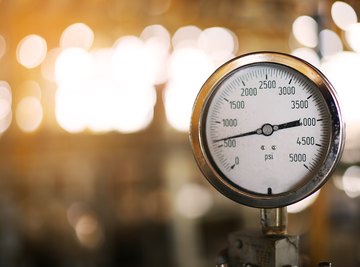
You may have seen the abbreviation kPa, for kilopascals, printed on the pressure gauge you use for the tires of your car. One kilopascal equals approximately 0.145 pounds per square inch (psi). Because the kilopascal is a unit of pressure, you cannot convert it directly to joules, which is a unit of energy. Think of joules as the product of a volume measurement and kilopascals, however, and you can easily make the conversion.
Multiply your value in kilopascals by 1,000 to convert to pascals using a calculator. For example, if your value in kilopascals is 0.037 kPa, work out:
A pascal equals 1 kg per meter seconds squared.
Multiply your answer by a value in meters cubed, which is a unit of volume. For example, if your value is 3 cubic meters (m3), work out:
Write your answer using the correct units. For example, 111 kilogram meters squared per second squared.
Note that 1 joule equals 1 kilogram meter squared per second squared. Write your answer in joules, for example, 111 joules (J).
References
About the Author
John Woloch writes professionally for various websites. He has published in the Dutch journal "Crux" and writes frequently on oil painting, classical languages and topics involving math and biochemistry. Woloch holds a Master of Arts in English from the University of Chicago, a Master of Arts in classics from Ohio State University and a postbaccalaureate pre-medical degree from Georgetown University.