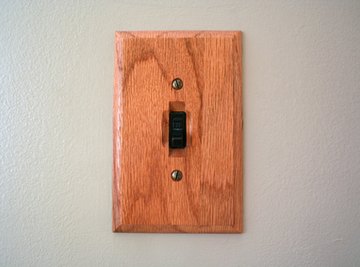

At its simplest, an electrical circuit transfers electricity from the negative terminal of a battery, through a wire, to the positive terminal of the battery. If you wire a lightbulb into the circuit, the electricity will power the bulb. In real world applications, it's generally desirable to have a way to turn the bulb off -- that's where a switch comes in. Switches give you a way to interrupt the circuit so that the electricity can't get from the negative terminal of the battery to the bulb unless the switch is closed.
- 36 inches of insulated copper wire
- Wire strippers
- Needle-nosed pliers
- Insulated knife switch
- Screwdriver
- D battery
- Masking tape
- Lightbulb socket
- Lightbulb
Make a variation of the circuit by replacing the lightbulb socket with a doorbell and the knife switch with a button switch. Press the button and the doorbell will ring.
Never use electricity from a wall socket to power this simple circuit. Doing so may cause serious injury.
Strip 1 inch of insulation from both ends of three 12-inch lengths of insulated copper wire. Use wire strippers or carefully cut through the insulation with the wire cutters on a pair of needle-nosed pliers and pull it off with the jaws. Bend the exposed wire ends into a "U" shape with the pliers.
Connect the end of one piece of wire to one terminal of an insulated knife switch by looping the "U" shaped bend in the wire around the terminal screw and tightening the screw with a screwdriver. Open the knife switch. Attach the other end of the wire to the negative terminal of a D battery by placing the "U" shape over the metal end of the battery and sticking a piece of masking tape over it to hold it.
Attach one end of the second piece of wire to the other terminal of the insulated knife switch and tighten the terminal screw. Connect the other end of the wire to one of the terminals on the lightbulb socket and tighten the screw.
Connect one end of the third piece of wire to the second terminal on the lightbulb socket and tighten the terminal screw. Screw a bulb into the socket. Attach the other end of the wire to the positive terminal of the D battery by placing it against the metal terminal and taping it in place with masking tape.
Check to make sure all the connections are secure. Close the knife switch to complete the circuit. The lightbulb will light up. Open the knife switch and the bulb will go out.
Things You'll Need
Tips
Warnings
References
Tips
- Make a variation of the circuit by replacing the lightbulb socket with a doorbell and the knife switch with a button switch. Press the button and the doorbell will ring.
Warnings
- Never use electricity from a wall socket to power this simple circuit. Doing so may cause serious injury.
About the Author
Based in central Missouri, Rachel Steffan has been writing since 2005. She has contributed to several online publications, specializing in sustainable agriculture, food, health and nutrition. Steffan holds a Bachelor of Science in agriculture from Truman State University.
Photo Credits
light switch image by Jim Mills from Fotolia.com