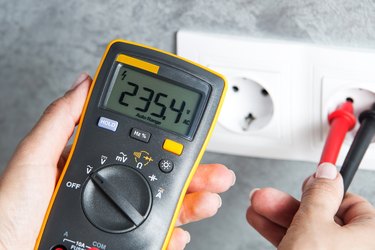
Whenever you're dealing with electricity of any kind, it is never a good idea to guess if the power is shut off. Testing for electrical power is the first and foremost safety precaution while dealing with electricity. Live power can be tested in a number of ways using different kinds of testers, but not all testers can be used for all applications.
Warning
Be sure to be familiar with proper electrical safety. Take care when using a tester that there are no loose connections, frayed insulation on the handles, or other damage that could cause injury. Check to make sure the testing device is rated for the work to be performed.
Video of the Day
The Multimeter: A General-Purpose Wire Tester
A good, reputable brand of digital multimeter is always the best option for checking power and testing electrical wiring. As the name implies, it has a multifunctional purpose in that it is able to test both AC and DC power as well as check continuity and amps. It can also test a variety of other functions that are used by professionals in various trades. Its downfall is that a multimeter requires the test leads to make contact with exposed wires.
Video of the Day
Using a Multimeter to Test Power
A digital multimeter is the best and most accurate way to check power. It can give an reading of the actual power and check that the circuit is being completed. To use one:
- Expose the wires to be tested.
- Plug the test leads into the multimeter (red is positive and black is negative).
- Set the digital multimeter to AC or DC, depending on the power you are dealing with. For instance, a car uses DC power and typical household power is AC.
- Touch the wire ends with the test leads and read the voltage on the digital screen. If testing an AC circuit, it is best to test both the hot wire (black) and the neutral wire (white). This will assure that both wires are doing what they need to do to complete the circuit. If testing DC, as in a car, check the power by touching the positive wire with the red lead while touching the black lead to a good, clean ground, such as the frame of the car.
Using a Multimeter to Test Continuity
Continuity or resistance is measured in OHMs, indicated by the Greek omega symbol on a multimeter.
- Check to make sure power is shut off.
- Expose the wires or fuse ends.
- Set the digital multimeter to ohms.
- Touch both red and black test leads to both wires or fuse ends. If the digital screen reads "OL," the circuit is open; if it displays a number, this are the ohm resistance reading — the lower the number, the better. It is recommended to not touch the leads and the wires with your bare hands. The human body can be a conductor and give a false reading on some multimeters.
Using a 12-Volt Circuit Tester Light
A 12-volt test light is an inexpensive way to check a circuit in cars or on any 12-volt DC system.
- Clamp the alligator clip to a good ground within reach of the 12-volt wire to be tested.
- Expose the wire.
- Touch the exposed wire to the probe on the 12-volt test light.
- Watch to see if the light lights up. If so, then 12 volts are present. This can be the best circuit tester for cars.
Using a Non-Contact Voltage Tester
Non-contact voltage testers are the safest way to test if power is present and can fit in a shirt pocket. Once again, the name says it all: no contact to the wire ends. There are non-contact voltage testers that are rated for various voltages; select one that is right for your application.
Turn on the non-contact voltage tester.
Verify with a known power source that the tester is working.
Apply the tip to the outside of a power wire to be tested.
Listen for an audible and/or light
indicator.
Verify again that the tester is working on a known source.
Testing Wires in Walls
Testing wires in the walls requires that you physically expose the wire. So either in the attic or in the basement, find where the wire goes in the specific wall and use the non-contact tester method for checking power to the wire.
To find where the wires are in the walls requires special detectors. These detectors are specific for the wall type, and some can be used on any kind of wiring. If you are uncomfortable with electrical work, then a call to an electrician may be the best answer.