
How to Become a Great Center in Football
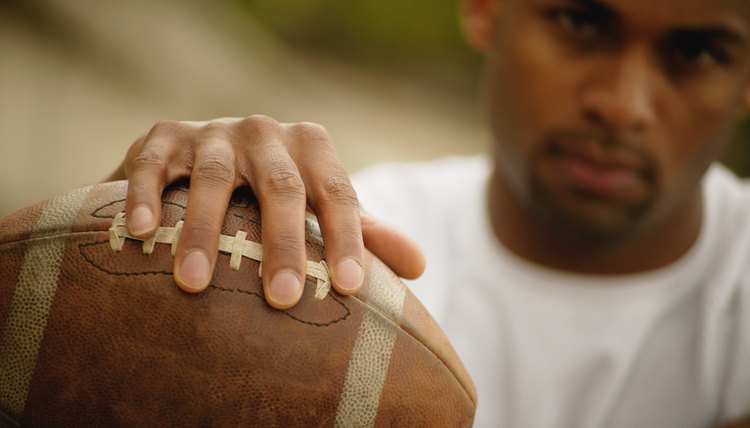
Elite football centers do more than snap the ball to the quarterback. They are powerful run blockers, often matching up against massive nose guards. They are excellent pass blockers, preventing pressure up the middle on the quarterback. They read defensive alignments, anticipate defensive play calls and yell out line adjustments. And they remain on the same page with the quarterback, making the same pre-snap assessments.
Reading Defenses
Great centers work in concert with the quarterback on reading defenses. You communicate with the other linemen as you read the alignment and anticipate blitzes, stunts and pass-rushing twists. You must study your opponents, learn their tendencies and read keys that indicate certain defensive play calls. Then you must make your own adjustments in mid-play to make sure defenders are blocked.
Consistency With Ball Snapping
Elite centers deliver the ball accurately and on time in all conditions. Your shotgun snaps must allow the quarterback to easily receive the ball while still surveying the defense. This becomes more difficult in noisy stadiums and on sloppy fields with wet footballs. You must remained focused on this task even while preparing to take on a powerful nose tackle or to slide left or right to pick up a blitz.
Athletic Development
Elite centers have powerful lower bodies so they can remain anchored against bull rushes. They tend to be a bit shorter than guards, typically 6-foot-2 to 6-foot-4. You must develop the upper body strength to take on 300-pound defensive linemen. You need quick feet and excellent balance to prevent players from shooting the gap to your left or right. You need enough speed to get to the second level of the defense and block would-be tacklers beyond the line of scrimmage. New York Jets center Nick Mangold told Muscle & Fitness where he focuses his training: "On the field, agility movements and close area explosion. In the weight room, your normal lifts like squat and bench. I will also do a lot of pushing and pulling with rubber bands to work my shoulders."
Run Blocking Technique
Centers are at a disadvantage when defenses put a nose guard on top of them, forcing them to snap and block at the same time. So you must stay low, use your free hand to gain leverage and take an explosive first step to drive back the defender. Develop great technique to make the most of your sheer strength.
Pass Blocking
Agility is paramount on passing plays. You must snap the ball and smoothly back-peddle into solid blocking position. Quick feet, long arms and fluid lateral movement are essential. Maintain low pad levels to prevent onrushing defenders from knocking you off balance by getting underneath your shoulder pads. Keep their weight over your feet and avoid reaching for or lunging at defenders.
References
Writer Bio
Jeff Gordon has been reporting and writing since 1977. His most recent work has appeared on websites such as eHow, GolfLink, Ask Men, Open Sports, Fox Sports and MSN. He has previously written for publications such as "The Sporting News" and "The Hockey News." He graduated from the University of Missouri-Columbia School of Journalism in 1979 with a bachelor's degree.