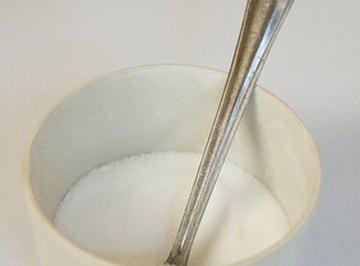
Perform two simple science experiments with salt to show how this mineral affects ice and water. The experiments, which use simple household supplies, are suitable for elementary school kids ages 8 to 12. First, you'll show how salt lowers the freezing point of water and melts ice to understand why so many people use salt in the winter for icy conditions. Then you'll demonstrate how much salt it takes to float different objects that otherwise sink in plain water.
Use Salt to Lower the Temperature of Ice
Measure 1 cup of cold water into each of the Styrofoam cups. Measure 1 tbsp. of salt into 1 cup, then mix well with spoon. Leave the other cup alone; do not add anything to it. Put both cups in the freezer for 10 minutes. Set a timer if you want. Hand out pencils and paper to all the children.
Pass a small plastic bowl to each child. You might want to make some ice cubes ahead of time and put them in a zippered freezer bag. Depending on how many kids you have, give them at least two ice cubes for each bowl. Have each child sprinkle salt on the ice cubes and watch them melt. The reason is that salt lowers the freezing point of water. It will freeze, but it has to be colder than the freezing point of unsalted fresh water. Put the bowls aside and ask the kids to write down what they saw and observed so far.
Pull out the two cups in the freezer when the timer goes off. You will find the cup with the plain water has started to freeze. The cup with the salt will not freeze because it has lowered the freezing point of the water. Ask the kids to write their observations about the experiment on the paper you provided. Tell them to keep the paper for notes on the next experiment.
Use Salt to Float Objects in Water
- Water
- Salt
- 2 large Styrofoam or plastic cups
- Measuring spoon
- Measuring cup
- Spoon
- Freezer
- Ice cubes
- Plastic bowl
- Paper and pencils
- Plastic or metal bowls that hold 2 cups water
- Water
- Several rocks or marbles
- Several apples
- Several raw or cooked eggs
- Paper towels for cleanup
Always wash your hands after you perform experiments.
Science can be messy, so have paper towels and spray ready for cleanup.
Always supervise children when performing science experiments.
Ask children not to rub their eyes or touch their face when performing salt experiments.
Pass out the bowls and teaspoons to every child. You will need a bowl or bowls that hold at least 2 cups of water. Make sure you have enough salt boxes for everyone to share and participate in the experiment. Fill every bowl with 2 cups of cold water.
Provide each child with a rock, marble, apple and an egg. They will add salt to the bowl one teaspoon at a time to find out how much salt is needed to make the object float. Have the children start with the egg because it takes about 9 tsp. of salt to make it float. Tell them to write their observations of the experiment on a piece of paper.
Let them try the apple next. It will take about 12 tsp. of salt to make the apple float. You may want to tell them it will take several teaspoons to float these heavy items. The last items for the children to float should be the rocks or marbles. It will take about 10 tsp. to make the marbles float and about 14 for the rocks.
Use other items such as pencils, pens and balls. The density of the item will determine how much salt you need to float it. Adding salt happens to make the water denser, so an item floats because water becomes denser than the item. Ask the children to record how many teaspoons of salt it takes to make each item float.
Things You'll Need
Tips
Warnings
References
Tips
- Always wash your hands after you perform experiments.
- Science can be messy, so have paper towels and spray ready for cleanup.
Warnings
- Always supervise children when performing science experiments.
- Ask children not to rub their eyes or touch their face when performing salt experiments.
About the Author
Joan Russell has been a freelance writer for many years. She writes on variety of topics, including food, health, gardening, travel and education. She's written for the Christian Science Monitor, IGA Grocergram, Home Cooking, Atlantic Publishing and Duclinea Media. She has a B.A. in journalism/communications from the University of Bridgeport and an A.S in food service management from Naugatuck Valley Technical Community College.
Photo Credits
salt image by Andrey Rakhmatullin from Fotolia.com