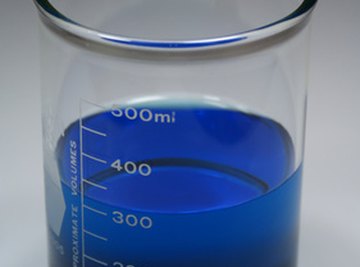

Materials float or sink based mainly on density. Since ice cubes are slightly less dense than water, ice cubes float in water. Since steel is less dense than mercury but denser than water, a steel ball bearing floats in liquid mercury but sinks in water. Understanding density begins with understanding how to calculate it.
Density Definition and Formula
Density is the ratio of mass to volume of an object, and as such, density is a calculated rather than measured value. Finding density requires measuring both the mass and the volume of an object. Density is used to describe solids, liquids and gases.
The density formula in chemistry is density equals mass M divided by volume V. Density may be represented by D or by the Greek letter rho (ρ), so the formula may be written as:
In geology, specific gravity is used more than density, but the two are closely related. Specific gravity consists of the density of the object divided by the density of water (1.0 g/cm3), yielding a dimensionless value.
Units of Density
For solids, the units of density in the metric system are usually reported as grams (mass) per cubic centimeter (volume) written as g/cm3. Density might also be reported as kilograms per cubic meter (kg/m3), kilograms per cubic centimeter (kg/cm3) or grams per cubic meter (g/m3).
Less commonly, density may be reported as pounds (mass) per cubic foot (volume), written as lb/ft3, pounds per cubic inch (lb/in3) or pounds per cubic yard (lb/yd3).
For liquids, density is most commonly reported as grams per milliliter (g/mL), while gas density is usually reported as grams per liter (g/L). Liquid and gas densities change with pressure and temperature, however, so will generally be reported in terms of standard pressure (one atmosphere) and temperature (25° C for liquids and 0° C for gases).
Measuring Mass
Finding the mass of solids requires the use of a triple-beam balance or electronic scale that measures mass. Place the sample on the tray, then follow the procedure for the tool to find the mass. If measuring mass of a powder or a liquid, first find the mass of a container, then add the powder or liquid and measure the total mass, before subtracting the mass of the container.
Measuring Volume
Finding the volume of a regular polygon simply requires measuring the dimensions of the solid and looking up the formula for the shape. For example, a rectangular block measuring 10 centimeters by 5 centimeters by 2 centimeters has a volume of 10 × 5 × 2 or 100 cubic centimeters.
Finding volume of irregularly shaped solids uses Archimedes principle of displacement. Measure a known quantity of water into a graduated cylinder, place the irregularly shaped object into the cylinder and read the graduated cylinder to determine the change in volume. The displaced water, shown by the change in reading on the graduated cylinder, equals the volume of the inserted object.
For liquids, the volume can be directly measured using the graduated cylinder.
Calculations to Find Density
To find density, divide the measured mass by the measured volume (D = M ÷ V).
Density Formula Examples: Solids
If a cube of a material measuring 1 centimeter on each side has a mass of 7.90 grams, the density calculation becomes
The material is most likely iron.
The mass of an irregularly shaped object is measured as 211.4 grams. The volume of water displaced equals 20 milliliters. Since one milliliter of water occupies one cubic centimeter of volume, the object's volume equals 20 cubic centimeters. Completing the formula shows
The material is most likely silver.
Density Formula Examples: Liquids
A liquid with a volume of 50 milliliters (mL) has a mass of 63 grams (g). So
The liquid is likely to be glycerine.
A liquid with a measured mass of 338.75 grams occupies a volume of 25 milliliters. Completing the density formula shows
The liquid is probably mercury.
Online Density Formula Calculator
Online density formula calculators are available. Two of the three variables (mass, volume or density) must be known, however (See Resources).
References
- Carleton College Science Education Resource Center: How do I Calculate Density?
- NASA Goddard Institute for Space Studies: Measuring Density
- U.S. Geological Survey: Water Science School - Water Density
- Southern Methodist University: Archimedes' Principle
- Palomar College: Density and its Applications
- New York University: Mass Versus Weight
Resources
About the Author
Karen earned her Bachelor of Science in geology. She worked as a geologist for ten years before returning to school to earn her multiple subject teaching credential. Karen taught middle school science for over two decades, earning her Master of Arts in Science Education (emphasis in 5-12 geosciences) along the way. Karen now designs and teaches science and STEAM classes.
Photo Credits
Beaker With Blue Liquid image by explicitly from Fotolia.com