How to Use Euclidean Geometry

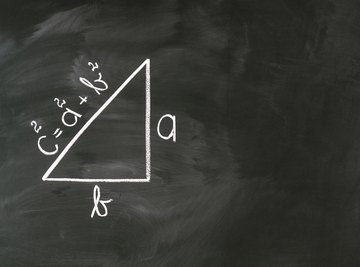
Euclidean geometry can be simply described as that old-fashioned plane geometry that you learned in school. It involves many observations that today we would simply call “common sense.” In the 20th century, Euclid’s observations and axioms concerning straight lines, right triangles and circles have been somewhat modified by Einstein’s theory of relatively, but for a large population of architects, builders, civil engineers and like-minded designers, Euclidean geometry is a way of life. Anytime we design a house or a table on a piece of paper, we have entered its world. Here are a few examples of the practical application of Euclidean geometry.

Things You'll Need

  • Pencil
  • Paper
Show More

Instructions

  1. How To Use Euclidean Geometry

    • 1

      On a piece of paper, design a table with four legs. This is really a very simple exercise that illustrates several practical applications of Euclidean geometry. Make the tabletop square. (Actually, this is not mandatory, but most of us today are used to square or rectangular-shaped tabletops, windows, picture frames or sheets of paper.) To make certain that a particular area is square, all one has to do is make sure each corner registers at exactly 90 degrees. However, with an understanding of Euclidean Geometry and the properties of right triangles, it is possible to determine if our four-sided shape is square without measuring each and every corner. If two corners are square, then the whole figure is square. Also, it is true that if both diagonal measurements are square, then the whole object is also square. This last geometric property is an invaluable way for builders and home-improvement workers to doublecheck their handiwork. Just by building a table, we can see this aspect of Euclidean geometry applied to our daily lives.

    • 2

      Design a two-story house. When you do this, you will first of all discover the properties of the right triangle as described in step 1. But as you design the second story of the house, you will discover the world of parallel lines, as described by the Greek mathematician and philosopher over 20 centuries ago. To concur with Western architectural standards, your house will have to have walls that rise at perpendicular angles to the ground and thus for all practical purposes act as parallel lines. This means that if all walls are continued straight up from the ground, then the second floor will be the exact size as the first floor.

    • 3

      Draw and design the layout for an oval-shaped racetrack that is to be used in track and field events at your local high school. If you study the shape closely, you might notice that your ellipse or oval is really a circle divided in two connected by two parallel and perfectly straight segments of gravel runway. This design exercise underscores Euclid’s understanding of the nature of a circle and also his most famous axiom, which says that any two points can be joined by a straight line. Euclid defined the creation of a circle from a center point, where a straight line of one constant length, the radius, determines the overall shape. If the two ends of your racetrack are circular in nature, then every spot on the circumference of the curve will be equidistant from one point that is located at the center of that same curve. Also note the obvious reference to Euclid’s theory about two points being joined by a straight line. This idea is easily illustrated by emphasizing the sprinting events that take place at a track and field event. In this event contestants run along a straight section of track to see who can reach the finish line first. In reality, the path of the runners is the same as connecting two dots on a piece of paper with a pencil and a ruler. As you can see, a verbal discussion of Euclidean Geometry can easily become very wordy and complex, but essentially most designers today live in the world of Euclidean Geometry. By better understanding this textbook view of squares, circles and triangles, one can become a better designer.

Tips & Warnings

  • Euclidean geometry, or plane geometry as the subject is sometimes called, boasts a wonderful wealth of knowledge for both builder and designer.

  • There are whole worlds that exist outside the reality of Euclidean geometry. Much of the Third World lives in homes made from mud walls and thatched roofs, which are often amorphously shaped structures.

Related Searches:

Comments

You May Also Like

  • How to Understand Non-Euclidean Geometry

    In the third century B.C., the Greek mathematician Euclid explored the basic geometry that's still taught in schools today. It explains the...

  • The Two Types of Non-Euclidean Geometry

    The Two Types of Non-Euclidean Geometry. For more than 2,000 years, Euclid was the final word on geometry. Every mathematician from 200...

  • Geometry Uses in Driving

    If you're like most high school geometry students, it's a significant time for you. You're preparing to or beginning to drive! Like...

  • What Different Types of Non-Euclidean Geometry Are There?

    Geometry came down to western civilization through the Ancient Greek mathematician Euclid, who wrote the first treatise on geometry, "Elements." Euclidean geometry...

  • Forms of Geometry

    Many people remember taking math in school, possibly not with very fond memories. Geometry is one of those many essential areas of...

  • How to Teach Geometry

    Understand the principles and applications of geometry. Geometry is an area of math which many find confusing and difficult to learn. You...

  • How to Do a Step-By-Step Geometry Proof

    Geometry proofs are probably the most dreaded assignment in high school mathematics because they force you to break down something you may...

  • How to Calculate Euclidean Distance

    Euclidean distance is the distance between two points in Euclidean space. Euclidean space was originally devised by the Greek mathematician Euclid around...

  • Elements of Geometry

    Geometry is a branch of mathematics that deals with shapes, dimensions, ratios and angles. Euclid, an ancient Greek mathematician, wrote a textbook...

  • Types of Geometry Proofs

    Types of Geometry Proofs. In geometry, a proof is a sequence of statements that leads to a valid conclusion. To solve a...

  • Geometry Poster Projects

    For students who are visual and creative learners, the logic of math does not always make sense. Posters on geometric concepts can...

  • Definition of Rays in Geometry

    Around 300 B.C., Euclid wrote one of the world's most influential books on mathematics. It has been translated into every major language...

  • What Types of Jobs Use Geometry?

    Most students have founds themselves sitting in a class, wondering, "When am I ever going to use this stuff?" The truth is,...

  • How to Use Geometry in Everyday Life

    The practical applications of geometry are abundant. Next time your child is complaining about his homework and asks, "When am I ever...

  • How to Find Euclidean Distance

    Euclidean distance is probably harder to pronounce than it is to calculate. Euclidean distance refers to the distance between two points. These...

  • Who Is the Father of Geometry?

    The oldest math book in existence is Euclid's Elements. Euclid is the father of geometry.

  • How Do Track Runners Use Geometry?

    Track runners run on what is called an "oval" track, though it actually consists of two semicircles connected by two straightaways. The...

  • How to Do Geometry Constructions

    Geometric constructions have been used for thousands of years to find distances, areas, and regulated forms. Although computer software, such as computer...

  • What Are the Three Undefined Basic Figures of Geometry?

    Geometry, a branch of mathematics that focuses on shapes and measurement, has three undefined basic figures: the point, the line and the...

Related Ads

Featured