Fossils are any artifacts that reveal evidence of a past living thing preserved by the Earth's crust. The four main types of fossils are trace fossils, petrified fossils, molds and casts and carbon film. Most fossils contain a small amount of carbon, but carbon film fossils are primarily composed of carbon.
Formation
Every living thing contains carbon. When an organism dies or a leaf falls, it sinks into the earth's layers and decomposes. A carbon film is made when the oxygen, hydrogen and nitrogen of the organism disappear, leaving a thin layer of carbon. This process is known as distillation or carbonization. If the layer of carbon is on a viable surface, usually under a body of water, an imprint of the organism will remain.
Look
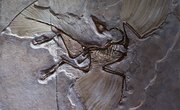
Carbon film fossils are usually black, dark brown or light brown in color, depending on the type of rock they are pressed upon. Unlike trace fossils, molds and casts, which form a three-dimensional shape of the object or organism, carbon film fossils are two-dimensional, like a drawing. They preserve an enormous amount of detail, such as the leaves and veins of a plant. Sometimes cells of the plant are even visible if the cells were filled with water.
Organisms
Carbon film fossils normally depict fish, crustaceans and plants. When the fish or crustaceans died, their bodies most likely sank to bottom of the body of water, were carried by the current and got wedged between or under rocks. This preserved their bodies from prey and destruction by the current. The plants preserved are commonly water-dwelling.
Carbon Dating
Due to the presence of carbon-14, carbon film fossils are relatively easy for scientists to date. Plants absorb carbon-14 from the air, and animals consume it when they eat plant life. At the moment of a plant or animal's death, the carbon-14 begins to decay. The half-life, or amount of time it takes for the number of atoms in any given sample to be reduced by half, is 5,700 years. Scientists are able to test the remaining carbon-14 in the carbon film fossil to determine its age.