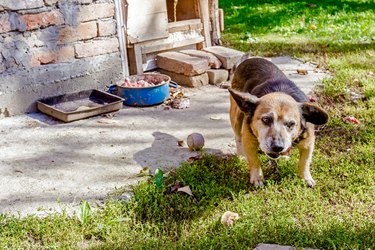
Brick makes a good all-weather dog house that will stay cool in summer and warmer in winter. You may choose full-size bricks or brick facade, which is cheaper and easier to use while retaining its durability. It is easiest to weatherize a brick dog house as the frame is being built. A little silicone caulk in the cracks, some Styrofoam sheet insulation in the roof and your dog will be comfortable year-round.
Step 1
Cut a door hole in one of the four matching sheets of plywood. Assemble the dog house frame by attaching the four plywood walls together using a nail gun. You will now have a partial cube with no roof.
Video of the Day
Step 2
Cut a 2" by 4" piece of lumber to fit between the side walls of the front of the dog house. Use 4" wood screws to secure it in place at the two sides of the dog house. It is not necessary to use screws along the front side. Lay the second 2" by 4" across the top of the front of the dog house, supported by the first 2" by 4" and flush with the front wall. Use 6" wood screws to secure it in place, about 2 inches apart across the front.
Step 3
Before finishing the roof, lay a bead of clear silicone caulk along the inside corner seams of the dog house to ensure a weather tight seal. Smooth the caulk so that your dog will not be able to scratch or chew away the caulk. Lay the larger plywood sheet on top of the dog house, sloped from front to rear, with a 3-inch overhang on all four sides. Secure with 2" wood screws. If desired, cut a piece of plywood to fit the gaps left from front to rear, or fill the gaps with Styrofoam. This is not necessary in a moderate climate, but if you will need to heat or cool your dog house for very hot or very cold climates, all gaps should be filled. You may also install an insulated pet door for harsh climates.
Step 4
If using brick facade, apply mortar to side of dog house, 1/2 inch thick, 2 brick widths at a time. If using full size bricks, apply mortar between each brick in the first row, then apply mortar to the top of first brick row. Stagger bricks at least 2 inches each time you go up a layer. Cut bricks or brick facade pieces as needed with a masonry saw to make corners and edges fit correctly. Miter bricks if necessary so they fit flush at each corner.
Step 5
Roll roofing or nail shingles in place. The flat, sloped roof will give your dog a place to jump up and look at things. Be sure to place the dog house well away from any pet fence to ensure your dog does not use its house to get out of the yard.
Video of the Day