

Things You'll Need:
- an orienteering compass
-
Step 1
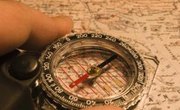
an Orienteering CompassFirst you need to be familiar with the "face" of the compass. Firstly, the compass always has four directions which are always marked on the face: North, South, East, and West. These four points are usually referred to as the "cardinal points" and the points in between (NE, NW, SE, SW ) are referred to as the "intercardinal points". There will also always be a movable arrow,(needle) which will usually have the arrow end marked in red, and a moveable housing (compass face) which is marked with "degrees" and the cardinal points. The "degrees" range from 360° or zero (at due north) and progress through the cardinal points: East ( 90° ) to South (180° ) to West (270° ). The base plate or housing of the compass also has an arrow, in the case of the orienteering compass, or a cutout line, in the case of the lensatic compass, which is the "direction of travel" indication or marking. The bottom (back end) of the "direction of travel" arrow is called the "index" and the top or the "arrow" part is called the "azimuth" or "direction of travel" or "heading" . All three of these terms are used to mean generally the same thing. The face of the compass will have two paralell marks beside the N which will "box" the end of the arrow (or needle) and placing the magnetic needle between these marks when following a direction of travel is referred to as 'boxing the needle".
-
Step 2
Determine where you want to go, either by sighting on the object you wish to reach or using a "bearing" previously determined with the use of a map.
-
Step 3
Firstly, begin by holding your compass properly against your body. For this discussion the orienteering compass is the one being used. You will hold the compass with the index of the base plate against your stomach or chest and the azimuth (directional arrow) facing outwards, at direct right angles to your body.
-
Step 4
If you have "sighted" an object towards which you want to go, simply face towards that object, look down at the compass, and allow the magnetic needle to "settle" so that it is pointed to North, and then rotate the compass face so that the Cardinal direction N is in line with the needle N, and make sure that the needle is "boxed" between the two lines on the face of the compass.
-
Step 5
You will notice that the directional arrow points exactly towards where you want to go.(If you are facing the way you want to go) and the "degrees" marked on the compass will be your "heading". All you do now is simply go forwards towards your goal, stopping every so often to realign yourself to the exact bearing, (the degree) that you have determined as your direction of travel
-
Step 6
To realign yourself with the correct bearing, re-set the compass face to your degree heading by rotating the compass face until the directional arrow is lined up with your original bearing you had chosen.(if the compass has been moved away from the original setting). Then simply rotate your body, holding the compass steady, until the needle N is "boxed", and go forward till you reach your goal.


Comments
digidi said
on 1/18/2009 Well written. Thank you.
Brett445 said
on 7/26/2008 such a simple thing but so many people don't know how to take a bearing with a compass. This is something that could very well save your life. So I think this is a very useful article. Thanks
acole said
on 7/22/2008 Ok. Interesting.