
Pelvic Realignment Exercises
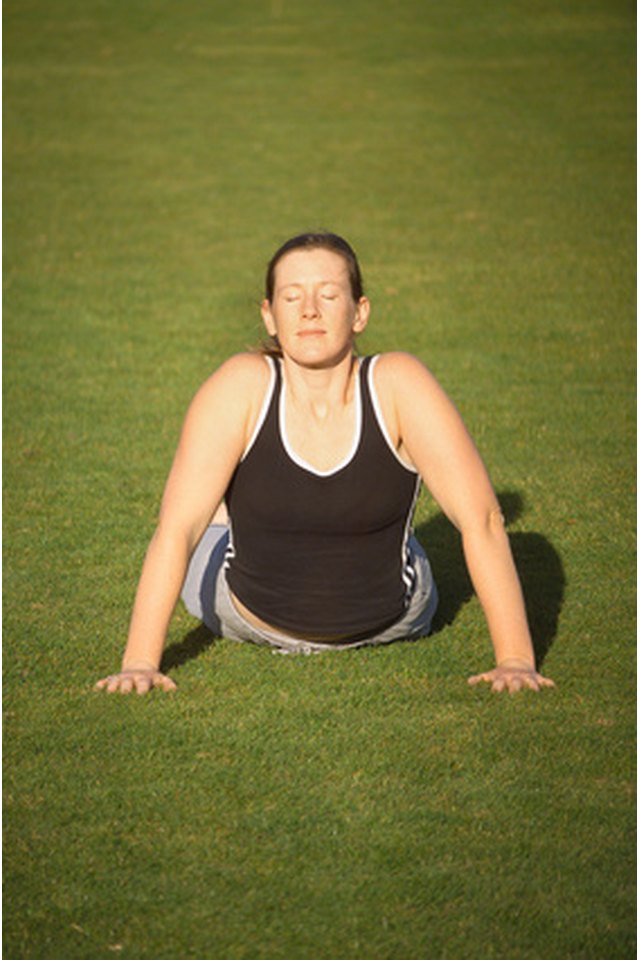
The pelvis and hips are the foundation of your entire skeleton, according to osteopathic Dr. Natalie Nevins. If they get thrown out of alignment, pain and tightness can spread up to the back and shoulders and down to the hamstrings. Accidents, injuries, muscle imbalances or poor posture can all tilt or rotate the pelvis out of its natural position. The good news is that regularly practicing gentle stretching and strengthening exercises can help realign the pelvis.
Supine Pelvic Tilt
The supine pelvic tilt is a basic, gentle exercise that helps to align your pelvis from the anterior to the posterior. Lie face-up on an exercise mat with your spine in a neutral position—a slight natural curve, with the abdomen flat. Imagine you are trying to balance a glass of water on your lower abdomen if you're having trouble finding your neutral position. Inhale deeply. As you exhale, draw your abs in as if you are trying to touch your spine with your belly button. Tilt your pelvis toward the ceiling. Hold for about 10 seconds and then return to the neutral spine position. Repeat eight to 10 times.
90/90 Hip Rotation
A rotated pelvis forces the spine out of its neutral position, causing pain and leaving the entire torso imbalanced. This exercise helps to rebalance the pelvis and hips.
Lie on your back on an exercise mat. Extend your arms out to the side. Bend your knees and hips at a 90-degree angle, and lift your feet of the ground. Using your oblique muscles (the sides of your waist), slowly rotate your knees and lower your legs to the left. Let your legs come to rest on the ground on your left side. Keep your right shoulder and lower back firmly connected to the floor throughout the move. Then rotate to the other side. Do at least 10 repetitions on each side. If one hip is weaker than the other, do a few extra repetitions on that side.
Reclining Butterfly
A restorative yoga pose, the reclining butterfly uses gravity to soothe and relax a misaligned pelvis.
Lie on your back on an exercise mat. Bend your knees at a 90-degree angle with your feet on the floor. Then allow your knees to open up and rotate outward as you touch the soles of your feet together. Relax your legs and allow them to fall open as far as they will naturally. Don't actively try to stretch here, just let gravity slowly pull your knees downward toward the floor. Breathe deeply and hold the position for as long as you comfortably can, working your way up to four to five minutes.
Bridge Variation
To perform this pelvis- and hip-strengthening exercise, lie on your back on an exercise mat. Your arms should be at your sides. Bend your knees at a 90-degree angle, your feet flat on the floor. Inhale and push off your heels to lift your hips up off the ground. As you come up, raise your arms up and extend them backwards over your head, as if you were swimming a backstroke. As you exhale, slowly roll your back down to the ground, curling your spine down one vertebrae at a time. At the same time, press your arms back down to your sides.
References
- "Viniyoga Therapy for Hips, Low Back and Sacrum"; Gary Kraskow, 2009.
- Women's Health Magazine: Hips Don't Lie
- FAQs: Hips and Pelvis Anatomy and Physiology