This Season
 

How to Build a Brush Arbor

For more than 1000 years, humans have invented ways to escape the summer heat, and brush arbors, like their cousins, tiki huts and palapas have been on the forefront of that effort. In the 1970s trendy missionary minded churches built brush arbors for meetings and traditional Vacation Bible Schools. For the most part though, the history of the brush arbor has been one of creating a shield from the hot summer sun and a place for families to gather for summer fun. Millions of people the world over can remember good times with family sitting in a brush arbor built out in the yard. Here’s how you can add to your own family traditions with a summertime brush arbor. These plans are for a brush arbor that is 9 feet tall and 10 feet square. You can adjust the design as needed for the space you choose.

Related Searches:
    Difficulty:
    Challenging

    Instructions

    Things You'll Need

    • 4 10-inch Wooden posts
    • 4 10-foot Wooden joists
    • 1 11-foort Wooden joist
    • 8 2-foot Lengths of wood or branches
    • 100 feet Sturdy rope.
    • Big pile of branches full of leaves.
    • 3-inch Nails or screws
    • Hammer or electric screwdriver
    • Shovel for digging
    • Level
    • Square
      • 1

        Plot out the area in which you will place your arbor. Safety first! Never build an arbor anywhere near a source of ignition, such as a fire pit. You will want a space about 12 to 15 feet square. Mark the corners with either a rock or some other identifiable piece of something.

      • 2

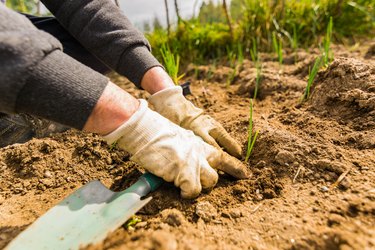
        Choose a corner in which to begin and begin by digging the first post hole about one foot deep. There is no need to dig in deeper unless you are planning to create your brush arbor structure as a permanent fixture on which only the roof is changed regularly. If that is your plan, then dig in 18 inches to two feet and lengthen your posts accordingly.

      • 3

        Select 2 posts and one joist. Lay the posts on the ground precisely 10 feet apart. Place the joist perpendicular to the posts at the very ends of both the joist and the post and nail or screw the pieces together. Do the same on the other side with the other post. Done properly, you should now have a square U shape lying on the ground. Brace the corners with one of the shorter board lengths connected between joist and post at 45 degrees and attached. Do this to both sides. Repeat this process with two more posts, one more joist, and two more short lengths of wood. Two of the bracing headers of your brush arbor are now finished.

      • 4

        Pick the bottom end of each post so that your U is standing perfectly vertical. Have a helper hold the contraption vertical with the joist on the ground. Take another joist and lay it down at the end of the connected joist in a perpendicular fashion that forms an L on the ground. Connect the new joist to the post.

      • 5

        Lay the contraption back down so that the U shaped portion is on ground and turn the contraption so that if stood upright with the joist on top, the last joist attach will join with the second U shaped contraption at the joist head. Lift it to do so, and with your helper, place both posts in the holes. Hold the end of the new joist to keep the whole contraption vertical. Ask your helper to lift the other U shaped piece to a vertical position and connect the pieces together into a U shape that should now be suspended, posts down and joists high, with four posts sitting in their holes.

      • 6

        Attach the shorter of the two remaining joists to connect the joists, closing the U into a square. Ask your helper to hold one end as you attach the first side.

      • 7

        Use the remaining short lengths of board to brace the unbraced sides as you did with the 45 degree angle boards on the first two structures.

      • 8

        Measure the distance between one pair of parallel joists at the center point. Cut your last length of board to fit in that space and connect it at the joist level. Your square should now be two parallel rectangles.

      • 9

        Using a length of rope, wind the rope around the joists, in what will essentially be a spiderweb of rope meshed over the entire canopy of the brush arbor.

      • 10

        Weave enough leafy branches into the ropes as it takes to completely cover the arbor, and to hide all of the rope from view. The purpose of the rope is to give a structure for the branches.

      • 11

        Fill in the holes in the ground surrounding your posts with wither dirt or cement.

      • 12

        Your brush arbor is ready. Serve a picnic supper complete with margaritas or tropical punch to christen your family’s new brush arbor.

    Tips & Warnings

    • For longest satisfying results, use green leafy branches. They will dry and eventually fell off, forcing you to to "re-roof" but you will do best to start with greenery. Use old roofs for kindling in a family bonfire that is held a safe distance from your brush arbor.

    Related Searches

    Read Next:

    Comments

    You May Also Like

    • The History of Brush Arbors

      A brush arbor is a rough, open-sided shelter constructed of vertical poles driven into the ground with additional long poles laid across...

    • Projects On Arbors

      An outdoor arbor can be a great place to get out of the sun and enjoy the fruits of your gardening labors....

    • How to Build an Arbor

      An arbor can be a beautiful addition to a garden or backyard setting. They are a simple construction project that can be...

    • How to Rebuild a Grape Arbor

      Grape arbors are subject to weathering, weight and insect damage over time. These can weaken the cross timbers. Settling can cause the...

    • How to build a sturdy grape arbor

      What could be more romantic than sitting under a grape arbor sipping the fruits of your own labor? Building a sturdy grape...

    • How to Build a Grape Arbor With a Cedar Pole

      Grape arbors are fun to erect and even more fun to enjoy when the grape vines start growing and spreading over it....

    • How to Build a Traditional Entry Arbor

      An arbor provides a nice entry into a garden or other outdoor space. It is a wonderful place for flowers to climb...

    • How to Make a Twig Arbor

      A natural rustic arbor is made from old branches and twigs usually found in the backyard. You can also create some unusual-looking...

    • How to Build a Palapa

      After many trips to Rocky Point, Mexico, My wife added the Custom Palapa to my "honeydo" list. Our build site required a...

    • How to Build Concord Grape Arbors

      If you're about to start growing Concord grapes, look forward to planting an authentic piece of Americana. Discovered growing wild in Concord,...

    • The History of Chinese Brush Painting

      According to the Asia-Art website, Chinese brush painting is an ancient form of art that originated in China around 4000 B.C. Typical...

    • How to Build a Garden Arbor Out of Branches and Limbs

      Intuition is better than detailed planning when your garden project is building an arbor from limbs, twigs, branches and found wood. With...

    • Arbor Flower Garden Plans

      Arbor Flower Garden Plans. Enliven the arbor and surrounding gardens with bold plants and flowers. Creeping, trailing vines with their bright foliage...

    • How to Make Your Own Yard Arbors

      Decorative arbors in your yard are focal points for your landscaping. Whether the arbors are covered with flowering vines, lights or both,...

    • How to Paint Vinyl Arbors

      People put a lot of time and effort into making their gardens as colorful and beautiful as possible. It's a shame that...

    • The History of Revivals

      In Christianity, a revival is an increased amount of interest in spiritual matters, over a specific time frame. A revival is generally...

    • DIY How to Build an Arbor or Pergola

      Arbors and pergolas have a rich horticultural history. Used in gardens for centuries, these structures are ornate as well as practical. In...

    • Arbors & Arches

      Arbors and arches are landscape structures which, when covered with blossoms, add charm as well as vertical interest to the landscape. Arches...

    • How to Make a Patio Arbor

      Patio arbors don't necessarily offer a lot of shade or shelter. But what they lack in practical purposes they make up for...

    Follow eHow

    Related Ads