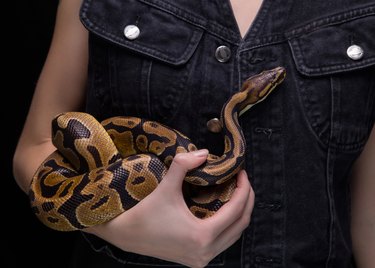
As snakes lack obvious external clues that indicate their gender, the best way to distinguish male and female ball pythons (Python regius) is to have an experienced keeper or veterinarian probe them. The process is minimally invasive, inexpensive and – for those experienced with the technique – relatively easy. Alternatively, if your ball python is very young, your veterinarian may be able try to manually evert the specimen's reproductive organs, although this option does not always provide conclusive results.
Reproductive Anatomy
Video of the Day
Male snakes have two intromittent organs called hemipenes (singular: hemipenis). These hemipenes reside inside the tail base when not in use. When mating, males evert one of the hemipenes and insert it into the female's vent, allowing for the transfer of sperm. Females have no hemipenes, although they have small pockets attached to the cloacal wall that are homologs of hemipenes.
Video of the Day
Probe Depth
Probing is a technique in which a keeper or veterinarian gently inserts a smooth steel rod into a snake's vent to determine the snake's sex. When the probe passes into the vent of a male, it enters one of the two inverted hemipenes; when the probe passes into the vent of a female, it enters one of hemipene homologs. Hemipenes are much longer than homologs are, thus allowing the probe to pass much deeper into the tail base of a male than of a female. By noting the depth to which a probe passes, you can infer the sex of the animal. Probes usually penetrate females to a depth equivalent to one to five scale rows, while probes pass about five to 16 scales deep in males.
Manual Eversion
Manual eversion of a snake's hemipenes – often called "popping" – is another technique that can provide clues about a snake's sex. To evert a snake's hemipenes, an experienced keeper or your veterinarian can apply gentle, rolling pressure (like squeezing a tube of toothpaste) to the snake's tail base. This usually causes a snake's hemipenes – if present – to pop out of the vent.
However, popping is not an infallible technique; it only produces definitive results in the case of males. For a variety of reasons, the hemipenes of males fail to evert sometimes, which can lead to males being misidentified as females. The technique is most effective when performed on very young snakes, as mature males may be able to keep their hemipenes inside their body.
Cloacal Spurs
Ball pythons – and most other pythons – bear two small clawlike appendages near their tail bases. Called spurs, these structures are the vestigial remnants of rear legs. Males use them to stimulate and position females during mating, so their spurs are normally larger than females'. However, exceptions are common, so spur size is not a reliable criterion for distinguishing males from females.
Husbandry Is the Same
Male and female ball pythons require similar husbandry. Females may grow a little faster, reach slightly larger sizes and have slightly larger heads than males do, but few other differences exist. Males tend to be slightly more common in the marketplace, as breeders often maintain two to four times as many females as males, thus making males more commonly available.