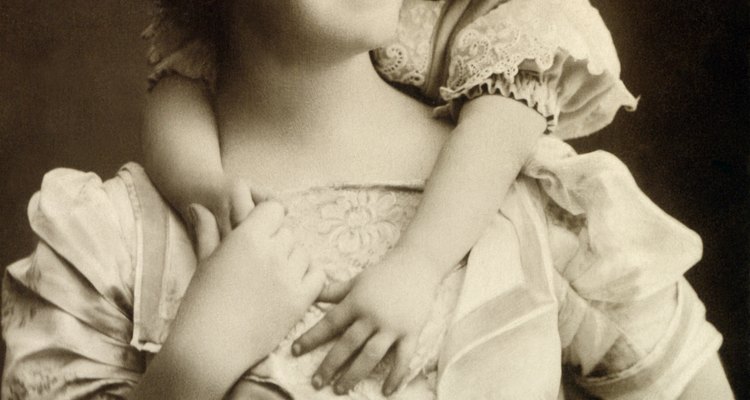
The "Gibson Girl" is a timeless image created by Charles Dana Gibson, a popular artist of the Victorian age. Drawings of Gibson's girls were used to illustrate catalogs, magazines and books. Although Gibson drew girls and women with hair arranged in a number of ways, the one most commonly associated with his work, and name, is the romantic, loose bun. Today, people still love this feminine hairdo. You can re-create the elegant hairstyle of the "Gibson girl" easily with just a few hair styling tools and some practice.
Set your with large hot rollers or use a curling iron to create large spiral curls. Place three rollers on top, at the back and on each side of the head. Spray your entire head of curled hair lightly with hairspray.
Flip your head upside down, gathering the hair at the top of the crown. Hold your head up and brush the hair smooth, but don't brush out the wavy curls. Pull the ponytail elastic over the gathered hair, double the elastic but don't pull the hair too tight.
Wrap the ponytail around the elastic, securing it in place with bobby pin, making a poufy bun. Spray the bun with hairspray. While the hair is still damp, use the paddle brush to smooth out the hair lightly.
Pull out two 1-inch sections, one from each side of the head using the pointed end of a fine-tooth comb. Wrap the sections around a curling iron or small hot rollers. Remove the curling instrument and use the fingers to loosen the curls slightly before spraying them.
Related Articles

How to Keep a Ponytail in All Day

How to Get Gorgeous Waves With Foam ...

How Do I Get Rid of Frizz in My ...

How to Preserve Curls Overnight
How to Curl Bangs Upward

How to Put on a Weave Ponytail Using ...

How to Straighten Short Curly Hair in ...
The Best Ways to Do a Gymnast's Hair
How to Do Pinup Curls
How to Use Hair Rollers for Short Hair

How to Get Loose Curls With Curlers

How to Make Hair Bows Stick to Baby Hair

How to Comb Your Hair Like Wolverine
How to Put in a Drawstring Ponytail
How to Use Sponge Rollers to Make Cheer ...
How to Make Hair Extensions Wavy

How to Make Frida Kahlo Braids
Dry Hair Treatment With Canola Oil

How to Get Curls to Stay in Fine Hair
How to Make a Small Bun Look Fuller
References
Writer Bio
As a former senior sales director with Mary Kay and the co-owner of a renovation company, Monica Patrick has firsthand knowledge of small business operations. Besides start ups, she has extensive skills in recruiting, selling, leadership, makeup artistry and skin care.
Photo Credits
Brand X Pictures/Brand X Pictures/Getty Images