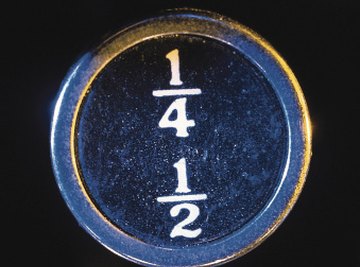

If fractions have you all tied up in knots, wondering how to divide fractions with ease, the good news is this: if you you can multiply you can divide fractions. As long as you know that a reciprocal fraction is just a fraction turned upside down so that, for instance, 3/4 becomes 4/3, and that a whole number over one is equal to the whole number, such as 5 equals 5/1, then dividing fractions should be a breeze. To divide mixed number fractions, you will have to convert it to an improper fraction before proceeding with the simple division algorithm. A few practice problems and you will be a master at dividing fractions without blinking an eyelash.
Simple Fractions
Read the fraction division problem such as 3/4 ÷ 5/8. Invert the second fraction to form the reciprocal so 5/8 becomes 8/5.
Rewrite the first fraction and the reciprocal of the second as a multiplication sentence 3/4 x 8/5.
Multiply the numerators together, then the denominators: 3 x 8 is 24 and 4 x 5 is 20. Therefore, the answer is 24/20.
Reduce the answer to lowest terms. 24 ÷ 20 equals 1 4/20. The greatest common factor (GCF) of 4 and 20 is 4 so divide the numerator and denominator by the GCF to simplify it and find the final answer, 1 1/5.
Fractions and Whole Numbers
Read a fraction division problem such as 9/15 ÷ 3. Write 3 as 3/1 and invert to get 1/3 as the reciprocal.
Write the equation 9/15 x 1/3.
Multiply the numerators and denominators: 9 x 1 is 9 and 15 x 3 is 45 making the product 9/45.
Find the GCF of 9 and 45, which in this case is 9. Divide both numbers by 9 to find the final, simplified answer: 1/5.
Mixed Numbers
For a tutorial on finding the greatest common factor to help reduce fractions to lowest terms, try Math Playground's "Factor Trees" exercise or AAA Math's drills.
Read a fraction division problem such as 8 1/9 ÷ 5/10. Convert the mixed number to an improper fraction by multiplying the denominator by the whole number, 9 x 8 is 72. Add the numerator, 72 + 1 is 73. The denominator remains the same so 8 1/9 equals 73/9.
Invert the second fraction so 5/10 becomes 10/5.
Rewrite the equation as a multiplication sentence with the improper fraction and the reciprocal, 73/9 x 10/5.
Multiply the numerators and denominators: 73 x 10 equals 730 and 9 x 5 equals 45 so the product is 730/45.
Divide the numerator by the denominator. The remainder is the numerator in the resulting mixed number, 16 10/45. Divide the new numerator and denominator by the GCF to reduce the fraction to lowest terms. The GCF of 10 and 45 is 5 so the final answer is 16 2/9.
Tips
References
- AAA Math: Dividing Fractions by Fractions; J. Banfill; 2009
- Math is Fun: Dividing Fractions; 2010
- Homeschool Math: Dividing Fractions 2a: How Many Times Does It Fit?; Maria Miller; 2011
- AAA Math: Dividing Fractions by Whole Numbers; J. Banfill; 2009
- AAA Math: Dividing Mixed Numbers; J. Banfill; 2009
Tips
- For a tutorial on finding the greatest common factor to help reduce fractions to lowest terms, try Math Playground's "Factor Trees" exercise or AAA Math's drills.
About the Author
Tamara Christine has written more than 900 articles for a variety of clients since 2010. She holds a Bachelor of Arts in applied linguistics and an elementary teaching license. Additionally, she completed a course in digital journalism in 2014. She has more than 10 years experience teaching and gardening.
Photo Credits
Comstock Images/Comstock/Getty Images