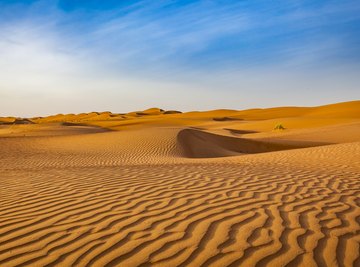

Deserts consist of very arid land, sparse vegetation, little rainfall and extreme heat. Rainfall must be under 10 inches yearly for a region to be considered a desert. Although deserts are usually very dry, drought can still occur if rainfall drops below regional averages. Creatures and plants native to the desert have many defenses against the environment, but severe drought will impact the most resilient plants, animals, insects and humans. Every living thing depends on others, and a type of domino effect spans all desert life when drought conditions peak.
Animals
All desert creatures have some form of defense against harsh conditions. Some can burrow underground where the temperatures are much cooler, while others enter a dormant state when temperatures peak. These defenses are efficient, but extended dry seasons and droughts will severely affect them. Animals are made mostly of water, and dehydration is a larger danger than starvation. Dormant creatures can only stay dormant for a duration of time, and many food sources such as plants and insects only flourish when there is adequate moisture to sustain them.
Nomads
Nomads are a culture of people without a permanent home. Nomadic people traverse many different environments and can found on every continent. Nomads generally follow migration patterns of animal herds. Humans and animals can prepare and survive periods of little precipitation quite well, but periods of drought severely hamper their travel. Drought conditions can cause strong winds and blinding dust storms. Food and water is sparse during dry periods to begin with. Once water and food resources run out, the herds sustain losses and nomads are soon to follow.
Plants
Plants in desert regions have vastly different defenses compared to plants in wetlands or forests. Some have very deep root systems which can draw moisture from the water tables. Others, like cacti, have no leaves with thick skin to retain moisture in its core. Drought effects desert plants, but not as dramatically as animals and people. Young plants are at most risk because of their lack of solid root systems. They can dehydrate, or be torn from the ground by wind and dust storms. Many young plants are tender food sources, and are targeted by nearly every living desert creature.
Insects
Insects and other creepy crawlers that inhabit the desert tend to have a thick exoskeleton to retain moisture that's similar to a cactus. Some can burrow into moisture rich plants and others feed on insects or blood. Drought impacts insects, but the percentage that die off hardly impacts the general population of insects because of their sheer numbers. Contrary, plants can suffer from insect losses if they pollinate via insects. Animals who feed heavily on insects may struggle to find reliable food sources. Parasitic insects will suffer if animals are heavily effected by the drought.
References
About the Author
Located in Wisconsin, Sean Hemmer has been writing professionally since 2010. Hemmer has contributed several articles to Gamewinners.com and has written for a blog titled "The Tequila Sunrise." He started attending Blackhawk Technical College during the year of 2008 in pursuit of an Associate of Applied Science in information technology/network administration.