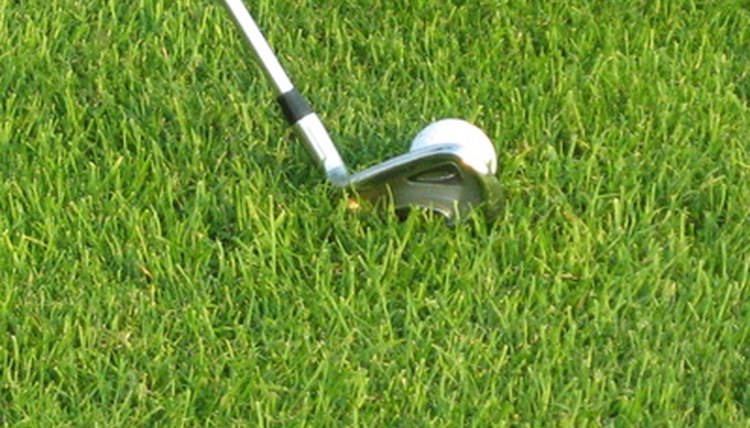
Things You'll Need:
- Golf Balls
- Golf Clubs
- Golf Gloves
- Golf Shoes
- Golf Balls
-
Step 1
Note that the following instructions are for right-handed players.
-
Step 2
Determine the trajectory needed for your golf shot.
-
Step 3
Select a low-lofted club, such as a 4- or 5-iron, that will fit the trajectory.
-
Step 4
Grip the club and address the golf ball.
-
Step 5
Position the golf ball in the back of your stance, near your right foot.
-
Step 6
Align yourself toward the target.
-
Step 7
Hold the club down on the grip, close to where the grip meets the shaft.
-
Step 8
Place your hands ahead of the ball, in a position known as a forward press.
-
Step 9
Swing the club back normally, stopping three-quarters of the way to the top of the swing.
-
Step 10
Swing down, hitting the ball.
-
Step 11
Stop the follow-through three-quarters of the way to the top.


Comments
Anonymous said
on 8/8/2006 I think that there is a less arbitrary and more dependable method for the standard punch. I am not talking about avoiding obstacles here or anything, but a shot that stays lower avoiding much of the wind.
Select two clubs longer than normal for the distance needed and choke down as far as you can without having any part of your hand actually on the shaft. (Roughly 2 inches depending on the size of your hands) All you have to do then is play your normal shot from your normal position. You will see that the ball goes considerably lower, gets the same distance as your normal club, and is much more dependable than making a bunch of changes to your normal set-up.
Those old rules of thumb that are still being repeated far too often fail to tell you about all of the downsides to those techniques. A "punch shot" in to a headwind with the ball in the back of your stance creates way too much back spin. This "low" shot will often balloon very high into a head wind for example. Not to mention all of the inaccuracy built into using such an under practiced set-up.
Keeping the ball at a specific height with a specific distance is much more intricate. Obviously one can hood the face of a lob wedge to match the initial trajectory of a driver. However the more you "hood" the more backspin you will be applying unless you can stop from releasing the club through impact. If you can pull that off, you aren't swinging the club anyway. I'm just trying to point out that leaning the shaft forward at an arbitrary angle will never produce predictable yardages unless you practice doing so extensively.
Specialty shots like these cannot be learned by anyone else's system. They are mastered at a range with very dedicated experimentation. The two club method above is a real punch shot and works only because you are decreasing club head speed (shortened shaft - choking down 2 inches) while also decreasing loft with normal backspin. (2 clubs longer)
Anonymous said
on 6/30/2006 I think that there is a less arbitrary and more dependable method for the standard punch. I am not talking about avoiding obstacles here or anything, but a shot that stays lower avoiding much of the wind.
Select two clubs longer than normal for the distance needed and choke down as far as you can without having any part of your hand actually on the shaft (roughly 2 inches depending on the size of your hands). All you have to do then is play your normal shot from your normal position. You will see that the ball goes considerably lower, gets the same distance as your normal club, and is much more dependable than making a bunch of changes to your normal set-up.
Those old rules of thumb that are still being repeated far too often,fail to tell you about all of the downsides to those techniques. A "punch shot" into a headwind with the ball in the back of your stance creates way too much back spin. This "low" shot will often balloon very high into a head wind for example. Not to mention all of the inaccuracy built into using such an under-practiced set-up.
Keeping the ball at a specific height with a specific distance is much more intricate. Obviously one can hood the face of a lob wedge to match the initial trajectory of a driver. However the more you "hood" the more backspin you will be applying unless you can stop from releasing the club through impact. If you can pull that off, you aren't swinging the club anyway.
I'm just trying to point out that leaning the shaft forward at an arbitrary angle will never produce predictable yardages unless you practice doing so extensively. Specialty shots like these cannot be learned by anyone else's system. They are mastered at a range with very dedicated experimentation. The two club method above is a real punch shot and works only because you are decreasing club head speed (shortened shaft - choking down 2 inches) while also decreasing loft with normal backspin (2 clubs longer).
Anonymous said
on 11/22/2005 Take your normal set up for a punch (ball back in stance, hands forward of the club head) and begin to hit your shot. Pound the back of the ball before you catch the ground and violently turn your hands over. This should lead to a low hook and hopefully get you back into the fairway.
Anonymous said
on 11/22/2005 It may help you to close the clubface at address, that is, to aim the club at the target with your feet aimed right of the pin, to help de-loft the club. Also keep in mind that the punch reduces yardage, so if a normal shot would be a 7-iron, you should think about a 6- or even 5-iron.
Anonymous said
on 11/22/2005 To ensure you don't scoop (or otherwise try to help the ball into the air), try to feel that you're leading your arms through the shot with the back of your forward hand (left hand for right handed players). And try not to let your hands roll over after impact. Try to keep the lead hand facing the target as long as possible through your follow through. This will help ensure the ball flies low.