Things You'll Need:
- Home Gyms
- Dumbbells
- Weight Benches
- Weight Belts
- Weight Lifting Gloves
- Health Club Memberships
- Plate Weights
- Weight Gain Products
-
Step 1
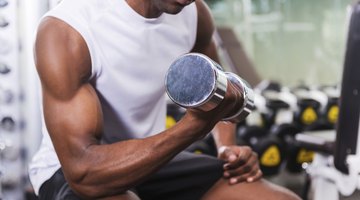
Grasp a dumbbell in each hand with a relaxed grip.
-
Step 2
Choose a weight lighter than 15 pounds. If you're a beginner, start with 3- to 5-pound weights.
-
Step 3
Stand with your back straight, knees slightly bent, abdominal muscles contracted. Your feet should be flat on the floor and shoulder width apart.
-
Step 4
Hold the weights at your sides, keeping your arms relaxed and your palms facing inward.
-
Step 5
Starting with your left side, turn your wrist so that your palm faces forward.
-
Step 6
Slowly raise the weight by bending your elbow. Keep your back straight, your shoulder relaxed and your elbow close to your side.
-
Step 7
Slowly raise the weight until your knuckles are 3 or 4 inches away from your left shoulder.
-
Step 8
Concentrate on contracting the biceps. Hold this position for 1 to 2 seconds.
-
Step 9
Slowly lower the weight back to its original position and turn your palm inward. Focus on squeezing the biceps.
-
Step 10
Repeat the exercise on the right side.
-
Step 11
The entire movement of each arm should last 5 seconds. Don't let the momentum do the lifting for you.
-
Step 12
Keep your back straight and your shoulder steady while letting your biceps do the work.
-
Step 13
Do one to three sets of eight to twelve repetitions for each arm.


Comments
fbrcold said
on 8/24/2009 What supplements do you use? I was wondering how well nitric oxide works. I saw http://nitricoxideeffects.com and was wondering if you know how much more power you gain when lifting?
RFerriANP said
on 12/18/2007 Remember when training biceps they only make up 1/3 of the upper arm. The triceps (back of the arm) make up 2/3 of the arm. So don't neglect training your tricepts.
jesterbones said
on 7/17/2007 I must call attention to a particular portion of the above article: "To tone the biceps without increasing its size, try using lighter weights and doing more repetitions. For mass, use heavier weights and fewer repetitions."
That is simply not true. "Tone" is a synonym for "muscle definition." Muscle definition is a factor of two variables: fat and muscle. The less fat that is over a muscle, the more definition of that muscle will be revealed. more repititions with lighter weight (above 15 repititions) is unlikely to invoke enough stimilus on the muscle to be useful-- it is basically just burning calories.
The upshot is this:if you are going to take the time to weight train correctly, then lift a heavy-enough weight that you can't do it more than 15 repititions. If you want to see more definition, then do exercise (in general) or eat less calories--both aimed at reducing body fat.
wangleehom said
on 3/15/2007 I'm just wondering. In order to obtain these results, how much should I lift and how long would it take? (I am planning to start with a 10lb dumbell) Suggestions?
Anonymous said
on 8/8/2006 To build big, powerful biceps, you must take 4 to 5 minute breaks between each set. This allows your biceps to fully recuperate for that extra tear. When lifting the weight, lift at a steady motion for about 2 seconds while breathing out. When letting the weight down, breath in and lower the weight even slower, for about 4 seconds. Resisting the weight hits the target muscle and avoids momentum.