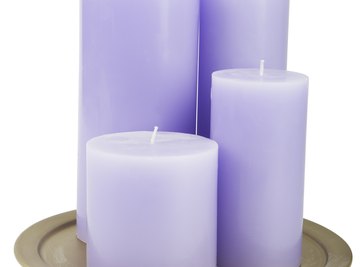
Obtaining the area of a simple two-dimensional shape like a circle or rectangle requires following a simple formula, but determining the total surface area of a three-dimensional object like a cone or closed cylinder requires the use of multiple formulas. A cylinder's surface area is composed of two circular bases and a rectangle. The latter represents the cylinder's lateral surface. Calculating the total surface area requires calculating the sum of the base and lateral surface areas.
Calculate the base areas by using the formula for a circle's area: A = pi * r^2. If the radius of the cylinder is 5, for instance, the area of one base is pi * 5^2 or 25pi, while the area of both of the bases combined is 2 * 25pi, or 50pi.
Multiply the circumference of the base by the cylinder's height to determine the lateral area's surface area. If you were to tear the cylinder open and lay it flat on a table, you would discover the lateral area is simply a rectangle whose length is the base's circumference and whose width is the cylinder's height. Given a radius of 5, the circumference is 2 * pi * 5, or 10pi. Given a height of 10, multiply 10pi by 5 to obtain a lateral surface area of 50pi.
Add the base areas to the lateral surface area to find the total surface area. Given the example, add 50pi to 50pi to obtain a total area of 100pi.
References
About the Author
Vivek Saxena has been a full-time freelance writer since 2004, contributing to several online publications. Prior to becoming a writer, Saxena studied computer technology at Purdue University.
Photo Credits
Photos.com/PhotoObjects.net/Getty Images