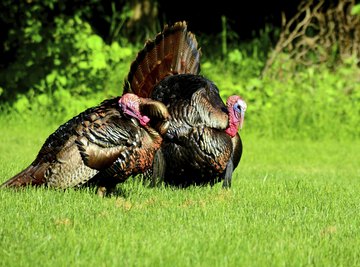

Turkeys are the quintessential Thanksgiving icon and an important North American bird. In fact, Benjamin Franklin made the case for the turkey as the national bird of the United States! However, the turkey famously lost to the bald eagle by a single vote. Most everyone knows what the colorful and enigmatic tom turkey looks like, but can you tell the difference between a turkey hen and a jake turkey?
What Is a Jake Turkey?
To learn how to distinguish jakes from turkey hens, you need to be able to answer the question "What is a jake turkey?" Though jakes can look a bit like turkey hens, or females, a jake turkey is a male that has not reached sexual maturity. A baby male turkey, or a poult, becomes a jake at about one year of age. Once he reaches two years old, he is known as a tom turkey.
Jake turkeys have a few key characteristics that can help you identify them. First, they have a short beard, which is a cluster of wiry black feathers growing from the center of their chest. Next, they have distinctively longer tail feathers in the middle of their tail. When jakes raise their tail feathers to display to females or other males, the middle feathers stand out an inch or two above the rest of their tail. Finally, jakes have short spurs growing from the backs of their legs. They will eventually use these spurs to fight with other males for breeding rights over females.
Turkey Hen Identification
The best way to tell a hen from a jake is to take a closer look at the typical characteristics of a hen turkey. Neither males nor females have feathers on their heads, and both can have some coloration of their heads and faces. However, while males have brightly colorful heads that flush red, white or blue depending on their excitement level, hens generally have dull gray or blue color on their heads. Females also do not grow the characteristic fleshy wattles on their face or neck like tom turkeys do.
Additionally, though bearded hens do exist, 95 percent of hens do not grow a beard on their chest like their male counterparts. Even rare bearded hens have short and wispy beards compared to those of males. Finally, hens do not grow spurs on their legs like jake turkeys and toms do.
Jake vs. Tom Turkey
You can consider several different factors when comparing a jake turkey to a tom. In the jake vs. tom turkey comparison, beard length, spur size and tail feathers all come into play. The tail feathers provide the easiest identification because you can see them from a distance and they require no measuring. Jake turkey tails stick up noticeably in the middle, while toms have uniform tail feathers.
Beard length also provides a noticeable distinguishing characteristic. Jake turkey beards measure about five inches or less, while the beards of toms can grow eight inches or longer. Spur length also differs between jake vs. tom turkeys. A jake turkey's spurs grow no longer than half an inch, while tom turkeys' spurs continue to grow through their second and third year.
Turkey Poult Identification
Perhaps the easiest to identify, young turkeys – also known as poults – have noticeable differences in their size, feathering and coloration when compared with adults. Poults grow quickly but are still noticeably smaller than hens and toms. They also have mottled brown and black feathers to help them blend in and hide from predators. Additionally, poults have short feathers on their heads, while adults have sparse feathering and bare skin on their heads.
References
Tips
- When in doubt, don't shoot at a wild turkey that you can't identify as a male, unless it's permissible in your area.
Warnings
- The presence of a beard or spurs is not a reliable indicator of whether the turkey is a jake or hen. While not common, hens can have a beard and spurs.
About the Author
Marina Somma is a freelance writer and animal trainer. She holds a B.A. in Psychology and a B.S. in Marine and Environmental Biology & Policy from Monmouth University. Marina has worked with a number of publications involving animal science, behavior and training, including animals.net, SmallDogsAcademy and more.
Photo Credits
Lightwriter1949/iStock/Getty Images