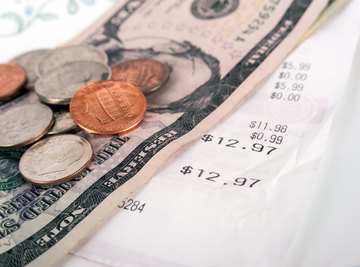

Percentages are everywhere in life: You use them to figure out how much to tip at a restaurant, how much of a work goal you've met, and how much that dress that's on sale will cost. No matter what the context, remember that percentages are actually fractions and proportions in disguise, which makes them a great tool for gauging the relative size of one thing against another.
Understanding Percentages
Here's why percentages are fractions in disguise: "Percent" actually means "one part out of every hundred." So once percent is one part out of 100 or the fraction 1/100. Two percent is two parts out of 100 or the fraction 2/100 and so on. Because percentages are always gauged against a common scale (out of 100), they're very easy to compare to one another. They're also easy to convert in and out of decimal form, which makes calculations easy.
Calculating Percentages
Divide the percentage by 100 to convert it into a decimal. So if you're calculating 20 percent, you have:
Multiply the original quantity by the percentage you want to figure out. For example, if you ate out at a nice restaurant, ended up with a bill of $90 and now want to tip 20 percent of that bill, you'd multiply $90 by 20 percent, express as a decimal:
$18 is 20 percent of $90, so if you received good service, that's how much you'd tip.
Working Backward to Find Percentages
What if, after that nice meal at the restaurant, you get a bill for $120 and hear it already has an 18 percent gratuity? You can use the percentage of the gratuity to work backwards and find out how much the bill was before the tip.
Add the percentage of the initial meal cost you originally paid (100 percent, which in plain English means "the whole thing") and the percentage of gratuity paid – in this case, 18 percent. So you paid 100 + 18 = 118 percent of the total meal cost.
Divide the percentage by 100 to convert it to a decimal. In this case, you have:
Divide the total amount you paid by the total percentage that represents. The result will be the cost of the original meal, before the extra percentage was added on. In this case, that means:
So your meal cost $101.70 before you added the 18 percent gratuity.
References
Resources
Tips
- If you are rounding a long decimal number to a money value, remember you are looking at the third number to figure out whether the second number will stay the same or round up. If the third number is five or above, round the second decimal up one.
- If your answer has only one digit to left of the decimal, add a zero if your answer is money. For example, if you find that 60 percent of $38 is 22.8, you will still need two decimal places because your answer is money. Add a zero to change 22.8 into $22.80.
- If your calculator has a percentage (%) button, you can type it into your multiplication problem exactly as you see it: 70 percent. For example, to find 70 percent of $45, you would type in 70% x 45 for a total of $31.50.
Warnings
- Make sure that when you are converting a decimal to a percent, you move the decimal two places to the right. You are making the number bigger.
- Make sure that when you are converting a percent to a decimal, you move the decimal two places to the left: no more or less.
About the Author
Lisa studied mathematics at the University of Alaska, Anchorage, and spent several years tutoring high school and university students through scary -- but fun! -- math subjects like algebra and calculus.