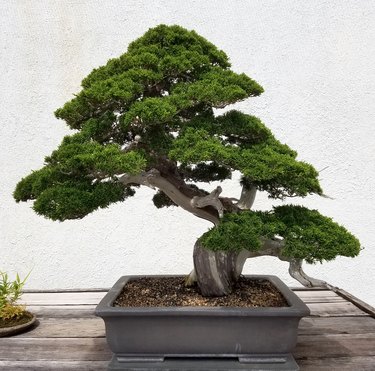
Juniper (Juniperus spp.) is one of the most tried-and-true bonsai plants, easy to care for even for novice bonsai gardeners. It makes an ideal decorative houseplant. Proper care for juniper bonsai trees ensures strong, healthy growth. Some junipers are naturally prostrate, such as Juniperus chinensis var. sargentii, while others are upright, such as Juniperus chinensis 'Fairview.' Both are perennials in U.S. Department of Agriculture plant hardiness zones 4 through 9. Regardless of their natural shapes, all juniper bonsai specimens are trained to resemble miniature trees, and they all require the same care.
Watering and Fertilizing
Video of the Day
The art of bonsai requires the pruning of a plant's roots so that it can grow in a small, shallow container. With the roots restricted this way, the plant's top growth develops into a miniature version of the plant's natural shape.
Video of the Day
Because small bonsai pots contain a limited amount of soil, adequately watering and fertilizing a juniper bonsai is critical to its health. Let the soil dry slightly before watering your juniper, but don't let it dry completely. If the soil surface is dry, water thoroughly until the excess flows from the pot's drainage holes.
From spring to early summer, fertilize potted plants with a 20-20-20 water-soluble formulation. This typically involved dissolving 2 teaspoons of fertilizer in a gallon of water applied at a rate of 1 quart per square foot of soil. Follow the label recommendations if they vary from this example. Withhold fertilizer in the summer and use the same formulation at one-quarter the recommended rate in the fall.
Sun and Soil
Juniper bonsai trees flourish in full sun as long as the soil does not dry completely. They grow best when they are periodically repotted. Typically, plants up to 6 years old need to be repotted every two years. Older plants need repotting every three to five years.
You can repot juniper any time during its growing season, using a commercially prepared mix labeled for bonsai, or a home made one. A suitable potting mix includes equal parts of humus or ground pine bark, sand or perlite, and clay. Don't give the bonsai any fertilizer for 30 to 60 days after transplant.
Pruning and Plucking
Typically, pruning a plant means trimming the above-ground parts. But to care for a bonsai plant, you must also prune its roots. Allow juniper to grow in its container with the roots intact unless it shows signs of decline or the roots heave it out of the pot. When either of these things happen, it's time to repot it.
To repot, remove the plant from its container, remove the soil from around the roots and comb the roots gently to separate them. Cut out the roots that have become stiff and wiry, and trim the softer fibrous roots, spreading them out when you repot the plant. Shape the top growth as desired by using scissors or hand-held pruners to snip the stems.
Don't use pruning tools to cut across the evergreen needles because the cut surfaces will turn brown. Instead, pluck out the tender new growth with your thumb and forefinger to style the plant.
Pests and Diseases
Sanitize pruning tools to prevent the spread of disease. The way to do this is to dip them for five minutes in a solution of 1 part bleach and 3 parts water. Rinse the pruners with water before making any cuts. The small size of juniper bonsai makes it easier to remove pests by hand instead of using chemical treatments, which may overwhelm the small plants.
Spider mites are occasionally a problem. You can spot these pests by gently shaking the juniper branch over a sheet of white paper. If mites are present, they'll drop and crawl on the paper. Spraying the foliage frequently with water dislodges the mites.
Bagworms — the larval state of some moths — can also be a problem. The moth constructs bag-like cocoons to serve as a house for the larvae as they feed on juniper foliage. It's easy work to handpick these cocoons and destroy them to prevent the caterpillars from feeding on the plants.