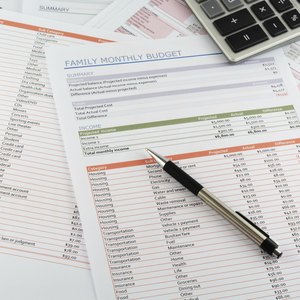


Every household needs a budget, a savings plan and a system for keeping household finances organized. While there are plenty of personal finance software programs available to purchase, there are just as many free options. In fact, all you really need to get started is an Internet connection or a spreadsheet program, an inexpensive organizer and a few file folders.
Adopt a Filing System
Set up a filing system that makes sense for your finances and situation. Although a month-by-month system is a good choice for most people, you might prefer to file monthly bills and credit statements by subject or category. For a monthly system, use a plastic tote and filing folders, or create and save an electronic filing cabinet consisting of a master “bills” folder and 12 subfolders -- one for each month -- in a convenient location on your computer. As monthly bill notifications arrive, download and save each one in the appropriate folder. Use a scanner or the scan option on your printer to upload documents that only come in paper form.
Choose a Tracking System
The easiest way to track household finances is with a desktop or online personal finance management program. PC magazine recommends Mint.com, a free online program that not only automates most money-management tasks but also provides options for connecting to most banks and credit card companies. These features reduce data entry errors and enable you to see exactly how and where you are spending money. As an alternative, use a spreadsheet to track household finances. Most programs have a variety of checkbook register, household budget and financial tracking templates to choose from, so you won’t need to create one from scratch.
Set Up Billing Accounts
Billing accounts eliminate the need to search for a creditor's contact information on bill-paying day. A financial management software program such as Mint.com will prompt you to create billing accounts as part of the getting-started process. As an alternative, create a master account list on paper. Identify each household biller or creditor, including the biller’s name, contact information, telephone number and website address. Include the account number only if you’re using the account set-up feature in an online financial management program. Otherwise, keep account numbers and website login information in a separate location. Set up billing reminders to alert you a few days in advance when a bill is coming due. Use the reminder feature in a software program or write payment dates on a scheduling calendar.
Establish a Weekly Routine
Set aside time each week to pay bills and track your spending, as even the most well-developed budget and tracking system won’t work if you don’t monitor spending. A regular schedule allows you to see whether you are keeping to your budget, and if not, helps you identify areas where you are overspending. A benefit to using an online program is the option to create spending reports, freeing you from having to make manual calculations. After considering the alternatives, either adjust spending in the offending area or adjust your budget.
References
Writer Bio
Based in Green Bay, Wisc., Jackie Lohrey has been writing professionally since 2009. In addition to writing web content and training manuals for small business clients and nonprofit organizations, including ERA Realtors and the Bay Area Humane Society, Lohrey also works as a finance data analyst for a global business outsourcing company.