
What does fact checked mean?
At SportsRec, we strive to deliver objective content that is accurate and up-to-date. Our team periodically reviews articles in order to ensure content quality. The sources cited below consist of evidence from peer-reviewed journals, prominent medical organizations, academic associations, and government data.
- Medline Plus: How to Make a Sling
- The Harvard Medical School Family Health Guide: How to Make a Sling
The information contained on this site is for informational purposes only, and should not be used as a substitute for the advice of a professional health care provider. Please check with the appropriate physician regarding health questions and concerns. Although we strive to deliver accurate and up-to-date information, no guarantee to that effect is made.
How to Make Homemade Arm Slings
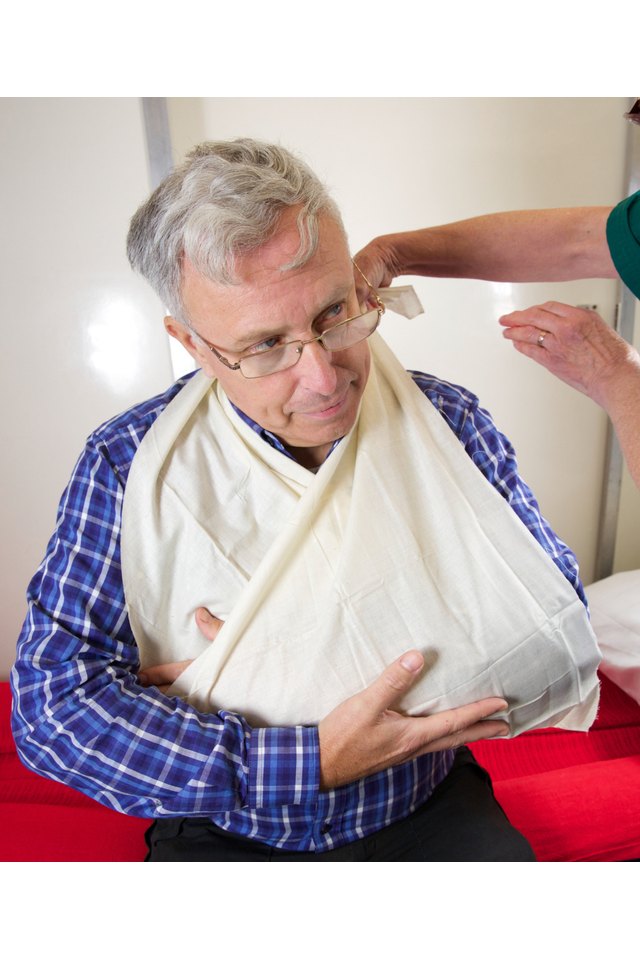
Arm slings are commonly used to immobilize, support and protect the arm or shoulder following an injury to the shoulder, upper arm, forearm or wrist. Slings are available to buy in a range of shapes and fabrics, but it is relatively easy to make a temporary triangle-type arm sling using a square or rectangular piece of cloth. Always care for wounds and apply a splint, if needed, before attempting to fit a sling.
Find a suitable square of fabric. If you don’t have a piece of cloth that is large enough, improvise with a pillowcase, sheet, bandana or towel. You can even use a shirt or coat.
Fold a cloth square in half to form a triangle. You can also cut a rectangular piece of cloth into a square before folding it, or cut the cloth into a triangle that doesn't require folding.
Have the patient support their injured arm so the forearm is roughly level. Slip one half of the triangle up and behind the injured person’s arm so the top point of the triangle (opposite the hypotenuse) is at their elbow, and their wrist lies along the middle of the triangle's bottom edge (the hypotenuse). Bring the loose end of that same side of the triangle up and over the shoulder opposite the injured arm and around the back of the neck toward the injured arm.
Bring the remaining loose end of the triangle straight up to meet the first loose end, and tie the two ends together at the side of the neck (nearest the injured arm). The sling should cradle the injured arm, with the elbow forming a right angle and the hand slightly higher than the elbow.
Twist or cinch up the loose fabric behind the elbow to form a pocket that covers and supports the elbow. Secure the fabric with a safety pin or by tucking it into itself.
Warnings
Seek professional medical help immediately if there is a dislocation, broken bone(s) or severe bleeding.
Do not attempt to realign an injured limb unless the skin looks pale or blue or there is no pulse.
Loosen or adjust the bandage if the person’s skin becomes cool, turns pale or blue, or if the patient complains of numbness or tingling. This could be a sign of nerve pressure or loss of circulation.
This information is not intended as a substitute for professional medical advice or treatment.
References
Writer Bio
Based in London, Lisa Green has been writing entertainment and women’s lifestyle articles since 2004. She has contributed to the MyVillage and Glam networks and is the former editor of Entertainmentwise. She holds a Bachelor of Arts in English from De Montfort University and a City & Guilds journalism certificate from the City of Bristol College.