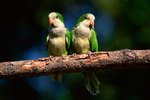
As of September 2013, it was illegal to own a quaker parrot in California, Colorado, Connecticut, Hawaii, Tennessee, Kentucky, Pennsylvania, Rhode Island and Wyoming. Ohio, New York, Virginia, Maine and New Jersey passed restrictions on quaker parrot ownership, requiring owners to obtain a license, clip captive parrots' wings or band your birds. Check your local ordinances to see if you can legally own a quaker parrot in your area.
Agricultural Threat
Many states have outlawed or restricted quaker parrots because they are viewed as agricultural threats. These birds multiply quickly. They lay five to 12 eggs, which hatch within 24 days. It is possible for a breeding pair to produce six clutches per year. Quakers form large flocks that can inflict serious damage on crops of fruit or grain. In South America, quaker parrots are threats to local farms, consuming pears, peaches, corn and apples. It is estimated that quaker parrots consume 2 percent to 15 percent of crops in the country. In some cases it has been as high as 45 percent. In the United States, these birds devour cherries, grapes, corn and pears.
Threat to Native Birds
Aggressive and territorial by nature, a flock of quaker parrots will dominate a food supply, keeping native birds from acquiring adequate nutrition. They will even kill smaller birds to keep them away from feeding areas such as bird feeders or fields of grain. Many state officials fear that if quaker parrots are allowed to multiply, the population of native bird species will be dramatically reduced.
Noise and Safety Factors
Quaker parrots build large communal nests from sticks and twigs. These nests can become so heavy that they cause their supporting structures to collapse. Quaker nests have been found on power poles, radio towers, church steeples and trees. In 2001, these nests were responsible for 1,027 power outages in Florida, costing the state $585,000 dollars. Between 2003 and 2007, it is estimated that Florida spent 1.3 million to 4.7 million dollars on nest removal. Large flocks of quakers make a substantial amount of noise, disrupting human neighborhoods. A flock of eight to 10 quakers can be heard for five blocks.
Health Concerns
Quaker parrots carry a disease called psittacosis, which can transmit to humans. One hundred to 200 cases are reported annually. Symptoms include a dry cough, fatigue, muscle and joint pain, as well as headaches. The disease is treated with antibiotics and is rarely fatal. Newcastle disease and Exotic Newcastle disease are two other illnesses that can be spread by the quaker parrot. These diseases can be deadly for native bird species and poultry.
References
- University of Nebraska: The Monk Parakeet: A Potential Threat to Agriculture
- The State of Queensland, Department of Employment, Economic Development and Innovation: Monk/Quaker Parakeet
- BirdChannel.com: Where Can You Own a Quaker Parrot? Infographic
- Quaker Information Center: Are Quakers Legal in My State?
- Medline Plus: Psittacosis
- Quaker Parakeet Society: Legal, Ilegal & Restricted States Listing
Photo Credits
-
Tom Brakefield/Stockbyte/Getty Images