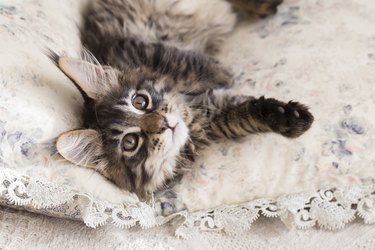
The Maine coon cat is not only the state cat of Maine but also one of the oldest North American cat breeds. There are some common Maine coon traits that will help you identify these cats, including their size, coat, and personality. It is possible that the cats got their name from the myth that the breed originated from a cross between a domestic cat and a raccoon. This is not biologically possible, but it does give you a good idea of what many of these beautiful cats look like.
Maine coon cat characteristics
Video of the Day
Maine coons are large, muscular cats with a long, rectangular body covered in long hair. Maine coon cats are slow to mature to their full size but should finish maturing by the age of 4. Male Maine coons weigh 18 to 22 pounds, while females of the breed weigh 12 to 15 pounds. They are a rugged breed and should be built to survive a Maine winter.
Video of the Day
Their legs are wide-set and their feet are large, tufted, and round. The cat's face features a square muzzle, high cheekbones, and wide-set, oval eyes. Eyes may be green, gold, green-gold, or copper in color, although white cats may have blue eyes. Their tufted ears have a wide base. The tail is long and fluffy and tapers toward the end.
Maine coon cats should have five toes in the front and four toes in the back. However, there is a mutation that caused Maine coon cats to have an extra toe on their feet. The International Cat Association classifies these cats separately as Maine coon polydactyls.
Maine coon cat colors
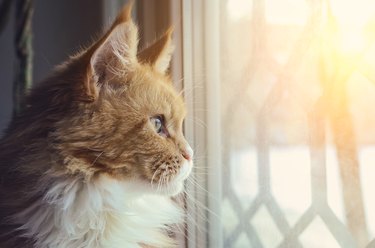
There are many colors of Maine coon cat accepted under the breed standard. In fact, no color is prohibited. The cats come in solid colors, including white, black, red, cream, and blue. Cream and white cats should have a pink nose and paw pads. Black cats should have a black or brown nose and pads. Red and blue cats should have brick red and blue noses and pads, respectively.
Tabby patterning is common in the breed, and the most common coloring is a brown tabby. Bicolored cats are white combined with cream, blue, red, or black. Other coloring and patterns include tortoiseshell and calico, or they may have one of these color patterns combined with a white undercoat.
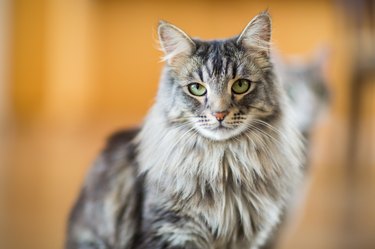
The coat is described as heavy and shaggy, but the hair is silky. The hair is shorter on the shoulders and longer around the back. They have a frontal ruff and full belly fur. The frontal ruff may not be as apparent in younger cats but will continue to develop as the cats age.
Maine coon cat personality
While breed is not a reliable indicator of temperament, Maine coon cats are generally described as gentle, friendly, and intelligent. In fact, their gentleness is sometimes a surprise due to their large size. They aren't generally lap cats, but they do prefer the company of their owners.
They stay playful throughout their life, and unlike many other cat breeds, most enjoy the water. The cats are excellent swimmers, and the long hair of the Maine coon is water-resistant.
Maine coon cats communicate vocally with their owners and when spotting prey. Rather than the meow you may expect from a cat, the Maine coon will often chirp or trill instead.