How to Identify Prehistoric Stone Age Tools

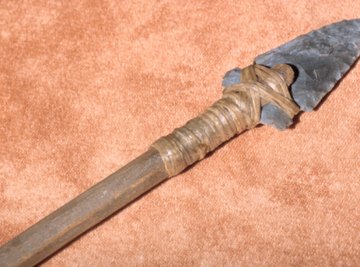
The term "Stone Age," a misnomer, describes any tools from human prehistory not made from metal. The greatest challenge with identifying Stone Age tools is that many items, such as bone and wood, have disintegrated over time or, in the case of stone, weathered and eroded. Although the task of tool identification may seem daunting, following these methods can make Stone Age tool identification easier and enjoyable.

Instructions

    • 1

      Read about the area where you found your stone "tool" or "manufacturing site" or where you plan to explore and the type of stone local to that area. Also read the works of archaeologists and the history of the people who once lived there (or nearby). Finally, read about or watch video documentaries that explore stone tool manufacture and reproduction.

    • 2

      Look around the area near your "site" for additional signs of Stone Age human habitation. This may seem like common sense, but many amateur Stone Age tool hunters forget that the Stone Age toolkit not only consisted of arrow heads, axes and scrapers, but included stone implements such as grinding stones in various shapes and sizes (look for unnaturally shaped ground surfaces, smoothness, and scratches or rubbed in grooves). Grinding stones (especially heavy, long food and grain grinding slabs), along with other archaeological evidence, such as post holes and hearths, point directly to human habitation.

    • 3

      Identify the type of stone located at your "site." Prehistoric humans used fine-grained or non-crystalline stone (for example, flint, quartz, shale or obsidian) that easily flakes when percussed to make some tools. Flaking stone by hitting one stone (the percussor or hammerstone) against another (the core), produced flakes of stone and continued flaking created serrated edges for cutting.

    • 4

      Search for local stone or large local raw material sources (for example, rocky outcrops or river beds) within a several mile range of your "site" as prehistoric humans tended to use readily available stone to manufacture tools. Evidence of manufacturing may be at the source site and not your own. If the "tool" at your site is not made of local stone, then you likely have a true artifact. The archaeological record and modern anthropological studies suggest that hard-to-find stone materials or tools were traded between prehistoric peoples just as modern humans trade goods.

    • 5

      Review the tool making trends of each of the Stone Ages (i.e., Paleolithic, or "old Stone Age," Mesolithic, or "middle Stone Age", and Neolithic, or "new Stone Age") and compare to your site findings.

    • 6

      Think ergonomics and hold your stone "tool" in your hand. Stone scrapers, made to easily fit in the hand, often included a "thumb rest."

Tips & Warnings

  • Building your knowledge base by combining research, traditional archaeology, modern stone tool reproduction techniques and ethnoarchaeology will improve your ability to look at a site and identify if the artifacts are from human origin or a work of nature.

Related Searches:

Comments

  • vivekbhaktha May 28, 2010
    It is good to know about prehistoric stone age tools. I saw a new stone age related article at Hubpages. The topic "stone age site at Gangavathi" is published at Hubpages. They found a place unknown to the people of the world.

You May Also Like

  • Prehistoric Stone Tools & Weapons

    The use of prehistoric tools and weapons began at the moment one human reached for a rock and used it to smash...

  • How to Make Stone Age Tools

    How to make stone age tools in this free How-to video.

  • Prehistoric Stone Tools

    Our ancestors discovered the practical use of stones millions of years ago, when they began to craft them into tools and weapons....

  • How to Identify Stone Tools

    In archaeology, stone tools are divided into two categories: "flaked" and "grinding" tools. Stone grinding tools were used in milling, abrading and...

  • Gem Identification Tools

    Gem Identification Tools. Identifying gems can be a profitable hobby or a lifetime career. Much of the information needed comes from the...

  • Stone Tools Used by Early Man

    Stone Tools Used by Early Man. Early man began using stone tools in daily life as far back as 2 million years...

  • Prehistoric Indian Tools

    Prehistoric Indian Tools. The Paleo-Indians or ancient Indians lived in the Americas, including the southwestern United States and northern Mexico, for 10,000...

  • Stone Age Knives and Tools

    The term "Stone Age" refers not to a specific era so much as to the long pre-metallic phase in the development of...

  • How to Identify a Stone Arrowhead

    Many people assume any stone tool that is pointed and triangular in shape is an ancient arrowhead, and most of the time...

  • How to Identify the Stone Tools of Native Americans

    Native American stone tools are durable artifacts, surviving from the end of the last glacial period, about 12,500 years ago.Stone age technology...

  • Indian Flint Tools

    Indian Flint Tools. Indian cultures of ancient America produced sharp cutting tools from flint through a process called knapping--flaking chips from a...

  • How to Identify Indian Stone Tools

    Stones provided Indians with a firm and strong material that could be made into tools. You can usually tell stone tools from...

  • Native American Stone Artifacts in Georgia

    The Woodland Indians made Georgia a permanent home residence and thrived there with a diverse society from about 1000 B.C. to 1000...

  • Tools Used in the Stone Age

    The Stone Age is considered the first period of prehistoric human technological development, preceding the Bronze and Iron ages. The Stone Age,...

  • How to Win at Stone Age

    "Stone Age" is a board game about running a prehistoric tribe. In order to win, you'll need to increase your tribe, gather...

  • About Wichita Tools

    The Wichita were a tribe of Indians that once lived in parts of modern day Texas and Oklahoma. These people formed their...

  • How to Measure the Age of Stone Tools

    Archaeologists use a variety of methods to estimate the time period a stone tool belongs to. In rare cases, they use absolute,...

  • Information on Stone Age Tools for Kids

    If you are teaching kids about the Stone Age and the people that lived at that time, you need to address the...

Related Ads

Featured