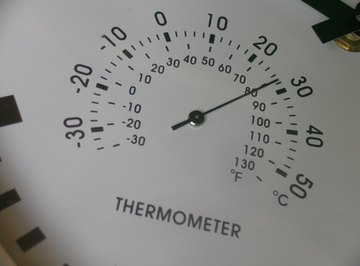

Most of the time in science, you want to deal with “objective” quantities. You don’t want the mass of a textbook to depend on who’s holding it, for example; it should just be the mass of the textbook by itself, as an objective measure of the amount of matter it contains.
Temperature is the same, starting from 0 degrees Kelvin (which is the coldest possible temperature) and increasing in a consistent way from that point onward. But human perception of temperature is also important, and that’s why in some circumstances you might need to look at a heat index forecast or calculate it to get an idea of how hot it’s going to be.
Heat Index Explained
The “heat index” is designed as a measure of the “feeling” of a certain combination of temperature and humidity to the human body. This sets it apart from the more objective measure of temperature, but most people will be familiar with the impact of a very humid environment on your perception of heat.
It’s important to remember that this isn’t as “scientific” as just listing the temperature and relative humidity, but that doesn’t mean that it isn’t a useful measure. In fact, in some cases it’s more useful to know the heat index than the temperature, and it’s used in weather reporting for that reason.
Heat Index Formula
The heat index formula is a long and kind of scary-looking equation, but the process of calculating it is pretty easy because it’s just a series of coefficients (factors you multiply by) attached to either temperature or relative humidity. These coefficients account for a few different things that would make it a very complicated equation, but they’re distilled into numerical values, so all you need to do is plug in your values for relative humidity and temperature and calculate.
The factors the formula takes into account include the surface area of the average human, how well skin radiates and absorbs heat, clothing cover and its resistance to heat and moisture transfer, sweating rate, core body temperature and much more.
Estimating each of these individually would make the formula difficult to use, but the values generally used are based on well-founded assumptions and averages, and so give a result that’s broadly applicable to everyone. The full heat index (HI) formula is:
T is temperature and R is relative humidity. It’s important to note that you should use Fahrenheit with this formula, so if you have a temperature in Celsius (or Kelvin), convert it first. Additionally, use a whole-integer percentage for the value of the relative humidity.
Calculate Heat Index With Formula
You can now use the formula to calculate the heat index. There isn’t a trick to this, and it’s just a long calculation where you have to be sure you’re entering the right values for the many coefficients and squaring the temperatures and humidity values where indicated.
You can put the heat index formula in Excel if you want a re-usable version of it, with cell references in place of the T and R values, so you can input the values for a specific day or location and get an automatic result.
Alternatively, there are many online calculators (see Resources) you can use to calculate the heat index for your chosen location. This is undoubtedly more convenient than calculating it by hand, and you might prefer it to Excel if you’re always going to have access to the internet when you need to perform the calculation.
References
Resources
About the Author
Lee Johnson is a freelance writer and science enthusiast, with a passion for distilling complex concepts into simple, digestible language. He's written about science for several websites including eHow UK and WiseGeek, mainly covering physics and astronomy. He was also a science blogger for Elements Behavioral Health's blog network for five years. He studied physics at the Open University and graduated in 2018.
Photo Credits
thermometer image by Alfonso d'Agostino from Fotolia.com