
What does fact checked mean?
At SportsRec, we strive to deliver objective content that is accurate and up-to-date. Our team periodically reviews articles in order to ensure content quality. The sources cited below consist of evidence from peer-reviewed journals, prominent medical organizations, academic associations, and government data.
- ExRx.net: Forearms
- American Council on Exercise: New Study Puts the Crunch on Ineffective Ab Exercises
The information contained on this site is for informational purposes only, and should not be used as a substitute for the advice of a professional health care provider. Please check with the appropriate physician regarding health questions and concerns. Although we strive to deliver accurate and up-to-date information, no guarantee to that effect is made.
How to Strength Train for Breakdancing
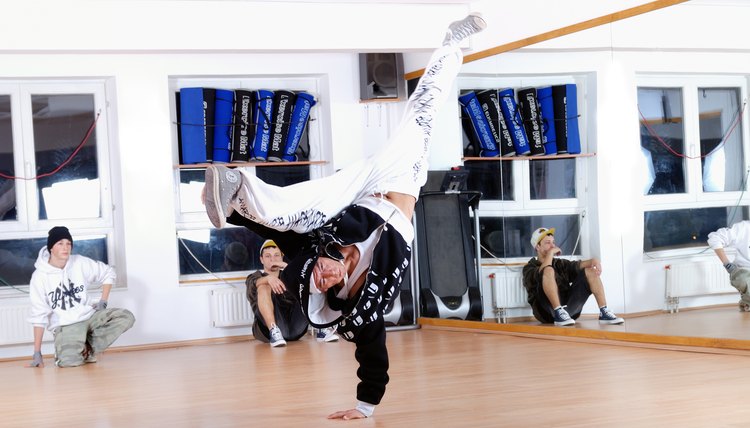
At first glance, breakdancers may look like human spinning tops. If you watch closely, however, you’ll observe that apparently effortless moves, such as handstands and explosive jumps, are actually quite difficult and require plenty of strength and balance. You can improve your breakdancing by performing some standard strength-training exercises -- such as plyometrics -- plus other activities specifically targeted for breakdancers. Although nothing will prepare your body for the rigors of breakdancing better than, well, breakdancing. Strength training can be great supplemental training, however.
Strengthen Your Wrists
Wrist strength is an important component in breakdancing, as you perform single- and double-arm handstands, for example. To strengthen these muscles, perform barbell or dumbbell wrist curls to train the wrist flexors in your forearms and do reverse wrist curls to strengthen the wrist extensors. If you have access to gymnastic rings, do false-grip pullups by gripping the rings as you normally would -- at the bottom of the ring, with the backs of your hands facing you -- but then slide your palm forward so the backs of your hands face the top of the ring. Perform eight to 12 repetitions of your selected exercises two to three times per week, but not on consecutive days.
Develop Your Core
Core strength is a key breakdancing requirement. A strong core helps support both upper- and lower-body dancing moves and helps improve your balance and coordination. Perform five minutes of captain’s chair exercises or do crunch variations, such as the bicycle maneuver, stability-ball crunch or vertical-leg crunch. You can also try the “dragon flag,” a Bruce Lee exercise that’s part of breakdancer Pierre Bleriot’s fitness program. Lie face up on a bench and then reach past your head to grasp the sides of the bench. Keep your shoulder blades on the bench and your hips straight as you raise your legs and lower torso as high as you can off the bench. Return to the starting position and rest for 15 seconds before doing more repetitions.
Total-Body Workout
In addition to focusing on the muscles that support your wrists and core, target other key muscles used in breakdancing, such as the muscles in your chest, upper back and shoulders as well as your triceps, biceps, quadriceps and hamstrings. Perform high-repetition activities using moderate resistance levels to strengthen your muscles and joints without bulking up. Use the heaviest weights you can lift about 20 times for each activity. Perform exercises such as bench presses for your chest, shoulders and triceps; lat pulldowns for your upper back and biceps; squats for your quadriceps; and leg curls for your hamstrings. Work each muscle group at least once per week.
Perform Plyometrics
Explosive movements -- such as squatting and then leaping to an erect position -- are used in many basic breakdancing moves. Plyometric exercises are designed to build the type of explosive strength required to perform these moves, including breakdancing jumps. You can take plyometric classes designed for dancers or perform a few plyometric exercises on your own. Beneficial activities include single- and double-leg horizontal and vertical jumps -- like standing long jumps; bounding exercises; and box jumps, in which you jump on and off a raised platform. Perform 40 to 120 total repetitions.
Program Notes
Warm up with five to 10 minutes of light cardio activity -- some relatively easy breakdance moves, for example -- before starting a strength-training session. Do strength-training workouts two or three times per week, but don’t train the same muscle group on consecutive days.
References
Writer Bio
M.L. Rose has worked as a print and online journalist for more than 20 years. He has contributed to a variety of national and local publications, specializing in sports writing. Rose holds a B.A. in communications.