

Subtraction tables help students memorize basic subtraction formulas and answers, which makes it easy for the students to learn subtraction. In the first grade, students learn all their tables up to 12, which prepares them for advanced work. A table contains 12 columns of 13 rows, starting with zero.
Create the Subtraction Table Template

Ask the students to pull out a sheet of graph paper and then divide the paper into 12 columns with 13 rows per column. Better yet, give each student a template they can use. Label the rows from 0 to 12, and then label the columns from 0 to 12, as well. Then, starting with the first row, write zeros across the table, proceeding downward in a diagonal direction, from the first column to the last column. This creates a pyramid shape.
Solve for the Remaining Rows
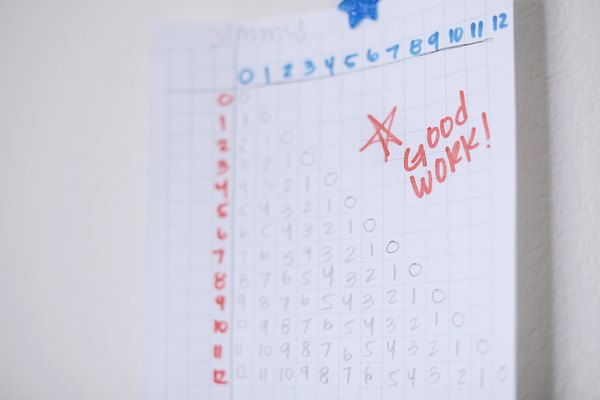
Hand the template to the students and instruct them to write the remaining consecutive numbers for each column vertically. For example, the first column starts with the zero you provided and then ends with 12. The second column starts with the zero provided and ends with 11. The students should work through every column in class or do the problems as homework. Work with each student individually until all of the students get the correct answer for every row. When finished, reward the students and proudly display their work on the wall.
Find the Missing Answers
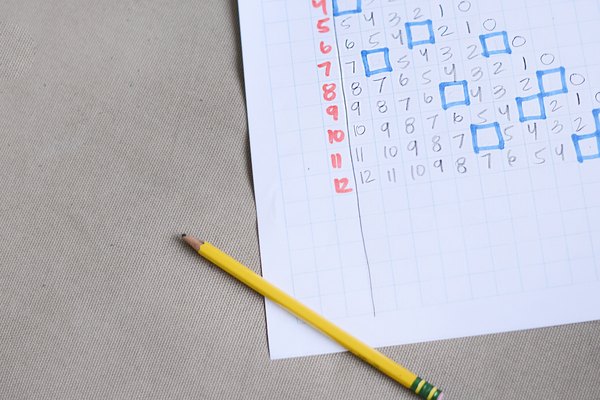
Once the students have finished their first set of subtraction tables, you can make the activity a bit less difficult. Create a complete subtraction table, with one number missing from each row. Ask the students to go through each subtraction table and find the missing answer. You can also let the students use the completed subtraction table they already created to find the answers. The act of searching for the right answer helps familiarize the students with the subtraction table chart.
Solve Subtraction Problems
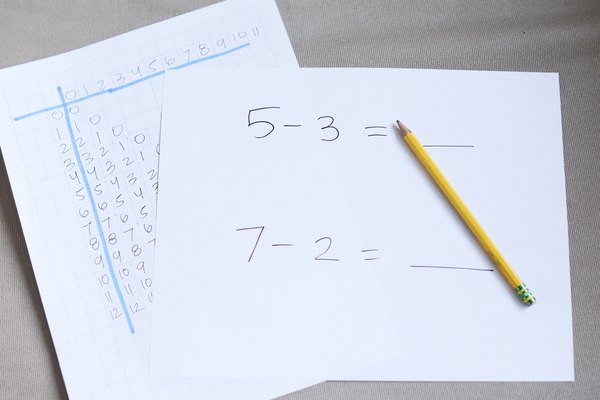
Now that the students know how to set up their own subtraction tables, give them a sheet of basic subtraction problems to solve, using the table. Some students may want to solve the problems without the table, but encourage them to use the table anyway. Show the students that to find the answer to a problem, they must find where the column and row for the two numbers in the expression line up. For example, if the students need to find the difference for "5 - 3" instruct them to find the row with the number five in it and trace their finger across the table until they arrive on the column for the number three. The number that their finger has landed on gives them the answer.
Create Pyramids

This fun activity can keep the students busy and interested in subtraction tables for an hour or more. Grab some construction paper and have the students cut the paper into triangles -- or you can cut the paper ahead of time -- if you prefer. Give the students a different color for each column on their subtraction table. Using the table they already created, have them write the answer for each row at the top of the triangle in one color, and the expression on the bottom left and right corner in another color. Show the students that when they subtract the two numbers on the bottom they get the answer at the top.
References
About the Author
Avery Martin holds a Bachelor of Music in opera performance and a Bachelor of Arts in East Asian studies. As a professional writer, she has written for Education.com, Samsung and IBM. Martin contributed English translations for a collection of Japanese poems by Misuzu Kaneko. She has worked as an educator in Japan, and she runs a private voice studio out of her home. She writes about education, music and travel.
Photo Credits
Alexa Smahl/Demand Media