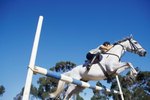
Whether making your own jumps or setting a jumping course, measurement is a big part of equestrian jumping. For jumps measuring 3 feet 6 inches high or less, your standards -- the end poles of each jump -- need to be at least 4 feet high. Five- to 6-foot standards work well for jumps below 6 feet high. Poles, gates or walls that fit between the standards range from 8 to 12 feet long. Standard hunter and jumper show jumps are 12 feet wide. Different disciplines, such as eventing, and advanced jumper courses will have some jumps that deviate from the standard 12-foot width. Finally, measuring your horse's stride helps to set the proper course for him.
Tips
Purchase your wood in precut lengths at your lumber or hardware supply store.
Things You'll Need
One 8-foot long 4-by-4-inch piece of wood
Two 8-feet long 1-by-4-inch planks
Power or handsaw
Power drill
One 1/2-inch spade bit
At least 16, 1 1/2-inch wood screws
Sandpaper
Measuring tape
Pencil
12-foot wood or PVC jump poles
Optional: Outdoor primer and paints
Tips
If you do not intend to paint your jump standards, purchase treated wood.
Make Your Standard Poles
Measure 4 feet on your 8-foot 4-by-4 wood piece. Mark it with your pencil, and cut it with your saw at that mark. You should now have two pieces measuring 4 feet each for your jump standards. Determine which end will be the bottom, and measure 18 inches up. Mark this with your pencil. Beginning at that 18-inch mark, proceed to measure and mark up your pole every 3 inches. These will be your holes for your jump cups and pins.
Tips
You can measure every 6 inches rather than every 3, depending on how much you want to raise or lower your jumps.
Drill Your Jump Cup Pin Holes
At each 3-inch mark, measure 1/2 inch from the edge of the wood and mark that spot with your pencil. This ensures that you are drilling in the center of the standard. Drill a hole at each mark using your power drill and 1/2-inch spade bit. Drill your holes completely through the standard pole. Sand your poles when finished, just until the poles are smooth.
Tips
It may be easier to drill your holes first with a 1/4-inch wood bit, then use that hole to guide in your 1/2-spade bit to finish each hole.
Cut Your Jump Feet
Measure and mark off four 20-inch sections from each of your 8-foot 1-by-4 planks. Use your saw to make cuts at each mark. When you are finished, you will have eight 20-inch pieces, four for each jump standard. If you like, use your pencil to draw a line at one corner of each foot piece, then cut this corner and sand. This will prevent a sharp corner from protruding at the base of your jump.
Tips
Jump feet can be cut from 2-by-6 boards, 12 feet long, for sturdier feet, each cut into four 16-inch sections. If you use this thickness, you will need 2 1/2-inch wood or decking screws.
Attach the Jump Feet to the Standard Poles
Line up the jump foot pieces, one at a time, so that the bottom of each is flush with the bottom of the 4-foot standard pole. You will use two screws to attach each foot piece, but just use one for now. Predrilling your holes may make it easier, but that's up to you. The footer pieces will be in a pinwheel patter at the base of the pole. When you have one screw in each piece. stand your pole upright and make sure the jump feet are all flush with the ground. Once they are, add the second screw to each piece. Do this with each standard pole. You can use additional screws if you want to make the feet more secure.
Finish Your Jump
Paint your standards if your wood is untreated. Then attach your jump cups. Set your jump standards to the width of your jump poles -- the standard hunter and jumper width is 12 feet. You can order them from an equestrian supplier, or ask your lumberyard to cut 12-foot lengths from a 4-by-4-inch piece. Another option is to purchase landscaping timbers or PVC pipe. Use paint or colored duct tape to add color stripes on your jump poles. You can add gates, walls, flower boxes, water trays and other jump "fills" in between your jump standards.
Set Your Jump Course
You can set your jumps at any width you want; some eventing and equitation courses set up jumps of smaller widths. A "skinny" jump is anywhere from 5 1/2 feet to 8 feet wide. These are more difficult for horse and rider because they require greater straightness and accuracy.
You also need to set your jumps at the proper distance between each jump. If you are setting an arena course, you need to ensure there is adequate room to turn safe corners at the end of the arena. A typical horse stride is 12 feet long, but every horse is different -- a 15-hand horse may have a larger stride than a 16-hand horse. If you want two strides between each jump, you will set them 36 feet: 24 feet for two 12-foot strides, then 6 feet for landing and 6 feet for takeoff to the next jump. If your horse struggles with this distance after a few attempts, merely adjust the jumps so they are closer or farther apart to suit his stride length.
Tips
Sand depth also affects how far to set your jumps. Your horse works harder in deep sand, so help him out by setting your jumps slightly closer together.
References
Writer Bio
Based in Central Texas, Karen S. Johnson is a marketing professional with more than 30 years' experience and specializes in business and equestrian topics. Her articles have appeared in several trade and business publications such as the Houston Chronicle. Johnson also co-authored a series of communications publications for the U.S. Agency for International Development. She holds a Bachelor of Science in speech from UT-Austin.