It might be true that if it looks like a duck, walks like a duck and quacks like a duck, it's a duck. But why do ducks do those things? Duck behavior is very different from most other barnyard animals, and understanding it is vital to having them as pets. For instance, ducks imprint within hours of hatching and must wet their food before eating. However, unlike wild ducks, most domestic ducks are flightless duck breeds, bred to be heavier so they don't fly away from the farm.
Video of the Day
Duckling and duck behavior
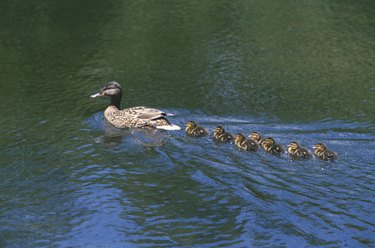
Who or what a duck sees in the first hour of his life will affect his behavior for the rest of his life. In the normal scheme of things, a duckling sees his mom and other duck siblings when he hatches and imprints on his own kind. When you watch a duck hatch in an incubator and interact with him during the first hours of life, he will imprint on you. While he'll be more than happy to nuzzle in your lap for much of his young life, he'll also want to be where you are at all times and peep or quack loudly when you're away.
Video of the Day
Duckling and duck feeding
Ducks make such a mess of food and water bowls at mealtime that it may be tempting to take away water when they are eating. Yet water is an essential part of mealtime for a duck, as they need to moisten each mouthful of food with water.
Unfortunately, when water is not available, they will continue to eat the dry food, setting the stage for the food swelling up and choking them once they have access to water again. Adult ducks prefer to feed on plants and insects under the surface of the water, often tipping completely upside down as they grab the goodies of their choice.
Duck mating rituals
Ducks can breed any time of year. Male courtship consists of shaking the head and tail with the breast held above the water. Flicking water at a female with the beak or swimming with outstretched wings and neck are other signs of a drake's interest. The actual mating can be brutal, with three or four males sometimes cooperating to impregnate a female.
Drakes are one of the few birds with a penis, and theirs is a corkscrew-shaped, oversized affair that can be as long as the male. The female protects herself from insemination from an unwanted male with a complicated vaginal barrel full of twists, turns, and side chambers. The complex oviduct enables her to sideline unwanted sperm and eject it later.
Duck nesting behavior
After allowing the male of her choosing to fertilize her, the female makes a nest in the ground with her beak. She'll lay a single egg into the nest each day, while reaching out her neck to collect leaves and grass to pad the nest. She'll also pluck feathers from her own breast to cushion the eggs and keep them warm when she begins incubation.
The male duck usually hides himself nearby to guard the area during nest-building and incubation, but takes no role in rearing the offspring. Theories suggest the colorful plumage of the male duck attracts predators. Domestic ducks must be housed during nesting because most are flightless duck breeds making them easy prey.