eHow launches Android app: Get the best of eHow on the go.

How To

How to Build Your Own Fish Tank

Contributor
By Jerry Garner
eHow Contributing Writer
Fish Tank
Fish Tank
jelene, Flickr.com Creative Commons License

Building your own fish tank is an activity that gives you a unique sense of accomplishment, on several different levels. Not only is it a gratifying experience to build your own fish tank from scratch, but it also has the added benefit of allowing you to have an exceptionally large fish tank. You could make a fish tank that is custom built to fit a specific area. Here is how to build your own fish tank.

Difficulty: Moderately Easy
Instructions

Things You'll Need:

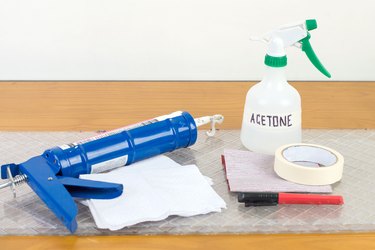
  • 5 Pieces of Glass (Bottom, Front, Back, Left Side and Right Side)
  • Silicon Sealant (100% Silicon – Non-Toxic)
  • Silicon Carbide Sandpaper
  • Acetone
  • Paper Towels
  • Duct Tape
  • Washable Felt-Tipped Marker

    Prepare to Build a Fish Tank

  1. Step 1

    Determine what size fish tank you would like to build. Once you know how large your fish tank will be, use an aquarium glass thickness calculator to determine how large and thick the glass for your fish tank should be. Glass thickness is a delicate balance. If you make your fish tank too thick, it will cost more money to build, but if you make it too thin, it may crack or even bust under the water pressure.

  2. Step 2

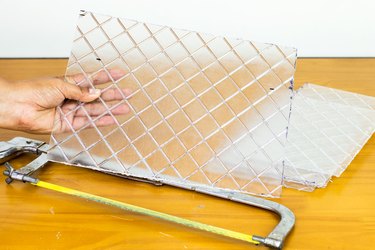
    After you have determined the size and thickness of the glass for your fish tank, place an order with a glass cutter. You will need to order five pieces total: for the bottom, front, back, left side and right side of the fish tank. Keep in mind that when you are building the fish tank, the bottom glass will serve as a base, and the outside pieces will be adhered directly onto the top of the bottom plate.

  3. Step 3

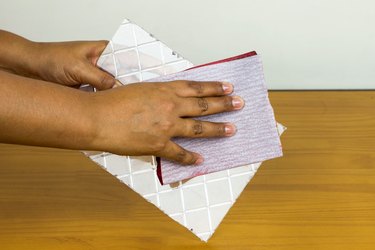
    Once you have received your rough cut glass, use your Silicon Carbide Sandpaper to sand down the edges of the glass. The edges will be rough and sharp from the glass cutter. Smooth it out as much as possible, but most importantly, files down any sharp edges on the glass. If you do not have Silicon Carbide Sandpaper, an emery cloth works just as well.

  4. Step 4

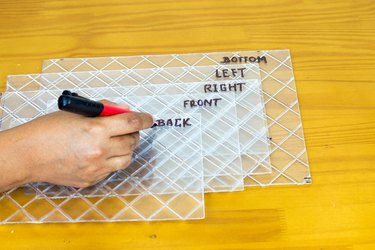
    Lay out all of the pieces of glass so that you can easily identify which piece is used for each position on the aquarium. Using a washable felt-tipped marker, write on the glass to identify which piece it is (bottom, front, back, left, right). Also mark which side is the inside of the fish tank, as well as which is the top and bottom edge.

  5. Step 5

    Proceed to the next Section, How to Build Your Own Fish Tank

  6. How to Build Your Own Fish Tank

  7. Step 1

    After you have prepared your glass and laid the pieces out, the first thing you will want to do is grab your roll of duct tape and begin tearing off strips. Each strip should be a couple of inches wide, and around 5-6 inches long. As you make a strip, lightly touch one end to the edge of your table or counter so that the strip will hang loosely, waiting until you need it. You will probably need to make 15-20 of these duct tape strips for the fish tank. You can always make more as you go, if you need them.

  8. Step 2

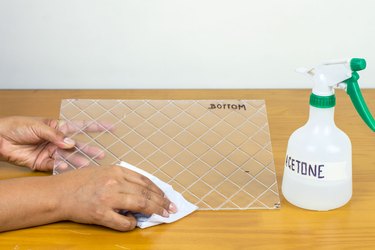
    Take the piece of glass that has been designated to be the bottom of the aquarium. Place it on the workspace in front of you, with the inside portion facing up. Splash a little acetone onto a paper town and use it to clean the edge’s all the way around the glass, so that you will have a clean surface for the Silicon Sealant. Remember, the sealant will be placed on the top surface of the glass, near the edge; not on the outside edge itself.

  9. Step 3

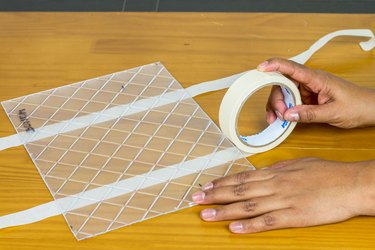
    Place eight of your duct tape strips under the fish tank. You will want them to be situated half under the tank, half out the side, with the stick side facing up. Place two strips on each side of the tank bottom, evenly spaced. This will allow you to provide a little extra bracing to the side pieces while you get everything put together.

  10. Step 4

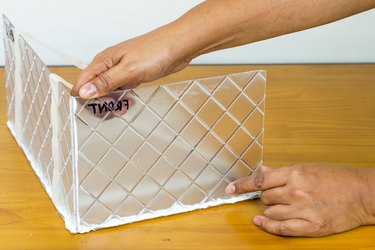
    Once the glass is clean and dry, identify the side the will be used for the front of the fish tank. Take your silicon sealant and run a bead of sealant down the length of the front of the fish tank. When you’re finished, locate the piece of glass that you identified as the front of the fish tank. Situate the glass so the up is up, and the inside/outside faces are in the correct position. Press the glass firmly down onto the silicon sealant, and with one hand, secure the duct tape strips. Do not attempt to wipe away any sealant that has leaked out under the edge.

  11. Step 5

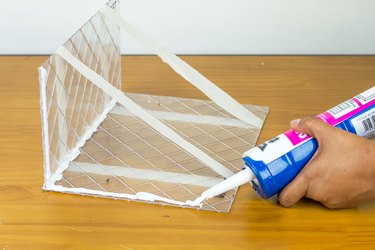
    With the front secured in place, you will now run a bead of silicon sealant for the next side of the tank, which will be either the right side of left side pane. Run the sealant both across the bottom, where the glass will be set, but also down the side of the front glass plate, where the two will meet.

  12. Step 6

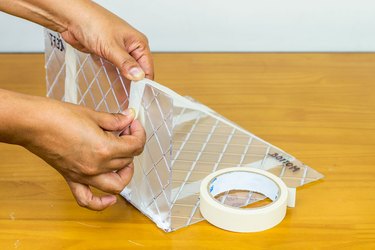
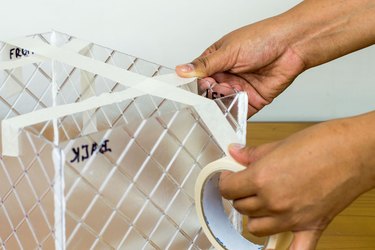
    Set the side panel in place. Make sure it is set firmly into the bottom glass, as well as the front glass. Hold the glass in place with one hand, and use your other hand to flip up the two tape strips from the bottom of the fish tank. Then take two new tape strips and secure them across the corner where the front and side meet.

  13. Step 7

    Continue this process until all four sides of the fish tank are secured to the bottom and to each other.

  14. Step 8

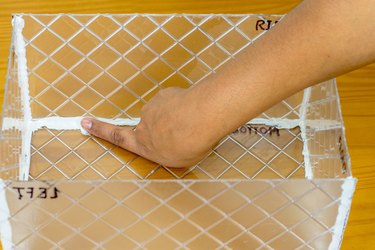
    Return to your Silicon Sealant, and run a small bead across all of the inside edges. This means a square all the way around the bottom inside edge of the fish tank, plus a line down each of the four inside corners. After the sealant has been applied, use your finger to smear it into the joints. This will help force the sealant into any areas that did not have any before. Let the sealant dry for at least 24 hours before moving on to the next step.

  15. Step 9

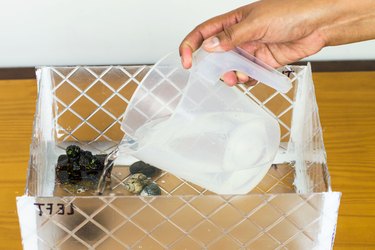
    Fill the tank with water, and allow the water to sit for at least 24 hours. Check the outside of the tank periodically for any slow leaks that may form on the joints. If the fish tank can hold water for 24 hours without developing a leak, it is ready to be used.

Tips & Warnings
  • Building your own fish tank usually doesn’t have much of a cost advantage over buying a tank, however, it allows you to have a custom tank designed to fit a specific area of your home or office.
  • Don't forget to take care of your fish with feeding and cleaning of the tank.
Subscribe

Post a Comment

Post a Comment

Related Ads

  • Have you done this? Click here to let us know.
I Did This
Get Free Pets Newsletters

Copyright © 1999-2009 eHow, Inc. Use of this web site constitutes acceptance of the eHow Terms of Use and Privacy Policy.   en-US Portions of this page are modifications based on work created and shared by Google and used according to terms described in the Creative Commons 3.0 Attribution License.

eHow Pets
eHow_eHow Pets