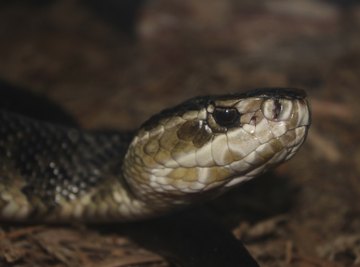
Cottonmouths, also called water moccasins, are venomous snakes that are native to the southeastern United States. Their territory stretches from Texas to the Eastern Seaboard, and from the Florida Keys to the middle of Missouri. The cottonmouth snake, a poisonous water snake, is often confused with non-venomous northern water snakes. While it is not advisable to get too close to a cottonmouth in order to identify it, you can discern some characteristics from a safe distance.
Warnings
While cottonmouths generally shy away from people, they do pack a serious venomous bite. Always give them plenty of space.
Body Characteristics
Cottonmouths may grow to three feet or more, but more impressive than their length is their heft: their bodies are thick and bulky compared to other snakes (such as northern water snakes) of the same length. Cottonmouths have tails that are short, and also thick. This snake’s body tapers at the neck, and its head is discernibly wider than its neck.
Head and Eyes
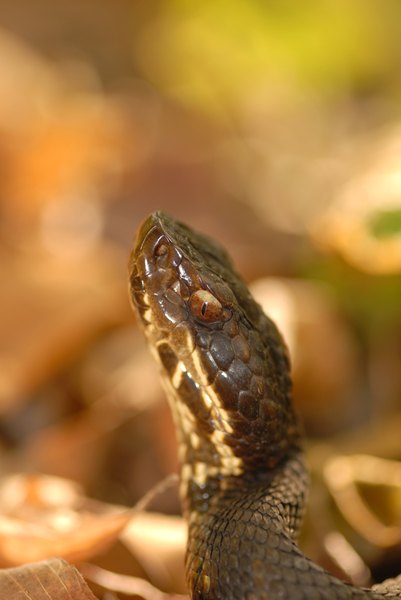
A cottonmouth’s head is arrow-shaped, and nearly triangular when viewed from the top. However, as a means of appearing larger than they really are, some non-venomous snake species flatten their heads when danger approaches. As a result, head shape is a more difficult means of identifying cottonmouths.
The snake’s head does appear more squared off at the edges, rather than rounded. Pits are visible between the eyes and nostrils, and the pupils in a cottonmouth’s eyes have a cat-like, elliptical shape. The pits are actually heat-sensitive organs that identify cottonmouths as part of the pit viper family of venomous snakes, which includes rattlesnakes and copperheads. Pits help these snakes find rodents and other warm blooded animals on which they feed.
Color Variations
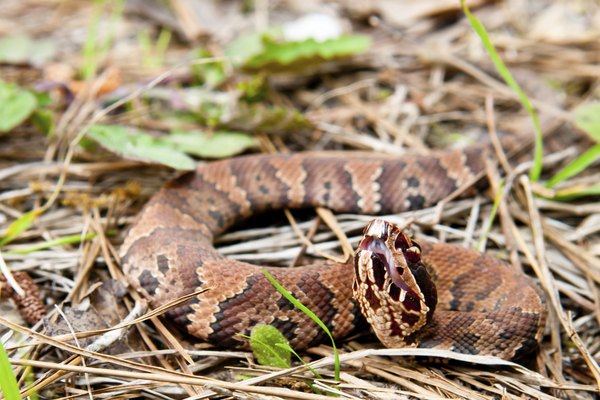
Young cottonmouths are tan to brown in color with as many as 10 to 15 darker bands across their backs. Tails start out yellow in color, which baby cottonmouths use as a lure with which to attract prey. As cottonmouths age, the tails turns more greenish, then finally black as the snake becomes an adult. Banding may be difficult to see in adult specimens as the snake’s body becomes dark brown or black as it progresses through adulthood. Adults have a white marking that extends from below each eye to the corner of the jaw. Adults also have a thin, pale white line above the eyes.
Cottonmouth Behavior
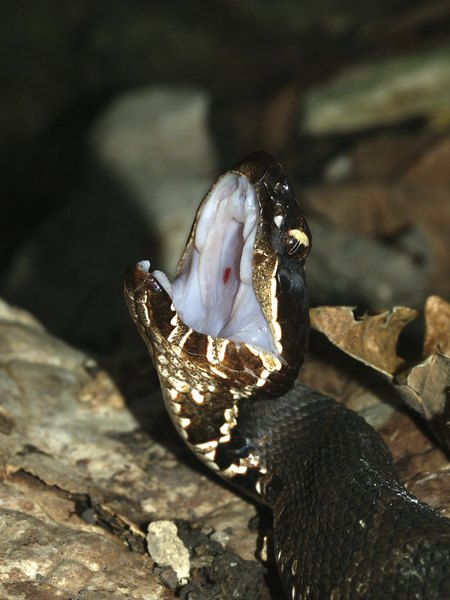
Most of the time, a cottonmouth will slip away unnoticed when humans approach. These poisonous water snakes will naturally seek water for escape if possible. When startled or threatened, a cottonmouth’s first line of defense is not to strike, but to brandish its wide-open mouth, which is pinkish to white in color. This display is what earned the snake its name, and the cottonmouth is the only snake species that behaves this way.
A cottonmouth also shakes its tail and emits a musky scent, warding off predators. All snakes have the ability to swim - a cottonmouth typically does so with its head above water. Its thick body gives it more buoyancy than thinner snakes, so the cottonmouth’s entire body often barely breaks the water’s surface as it swims.
Safety Around Cottonmouths
Learning how to properly identify a cottonmouth is one step in staying safe around these impressive serpents. Like other venomous snakes, cottonmouths aren’t out to bite people if they can help it. The danger comes from invading their space and making them feel threatened. It (hopefully) goes without saying you should never approach or harass a cottonmouth. Certainly if it’s performing its gaping defensive routine you’re too close: think of it that as a "friendly" message from the snake to back off.
It’s also possible to accidentally provoke a cottonmouth if you’re not watching where you put your hands or feet in brushy undergrowth or along riverbanks. If traveling off-trail in cottonmouth country, wear closed shoes or boots and long pants. Although stories abound in the southeastern United States of cottonmouths falling into canoes or kayaks from creekside branches, the chances of this happening are mighty slim.
References
About the Author
Robert Korpella has been writing professionally since 2000. He is a certified Master Naturalist, regularly monitors stream water quality and is the editor of freshare.net, a site exploring the Ozarks outdoors. Korpella's work has appeared in a variety of publications. He holds a bachelor's degree from the University of Arkansas.
Photo Credits
WizardGab/iStock/Getty Images