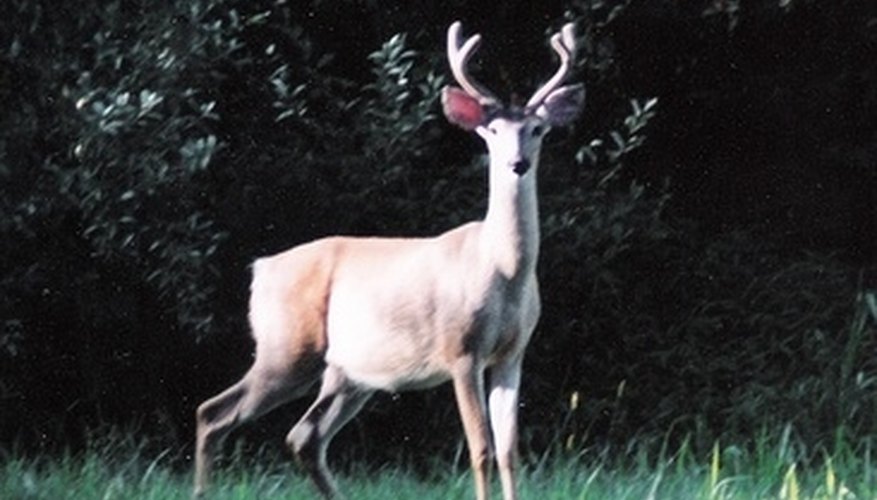


In order to process deer hides into suitable material for clothing, you will need to remove all of the flesh and other material adhering to the hide. The hides should then be tanned to prevent rotting and to soften it. Deer hides processed in this way are known as buckskin, which was commonly used for clothing by Native Americans. The clothes traditionally made from buckskin are leggings, shirts and dresses. Buckskin is more suitable for clothing than hides from animal such as elk as it is thinner and more pliable, but elk hides are more suitable for making moccasins than deer hides.
Items you will need
Blunt-edged knife
Wooden or plastic 15-gallon (or larger) barrel
1 gallon hardwood ashes
2 lbs. slaked lime
2 quarts vinegar
2 1/2 lbs. salt
Small 2-gallon wooden or plastic container
1 lb. alum
Neat's-foot oil
Sawhorse or metal pole
Wet cloth
Fine-grit sandpaper
Place the hide, hair side down, onto a flat surface. Cut away scraps of flesh from the hide with a knife. Use a blunt knife to scrape down the inside of the hide to remove more of the visible flesh. Keep scraping until all the flesh and fat is removed.
Fill a plastic or wooden barrel with five gallons of warm water. Pour in 1 gallon hardwood ashes and 2 pounds slaked lime. Mix to dissolve in the water.
Soak the hide in the solution for three to four days, stirring three times daily, until the hair falls off the hide. The hide should only be left in the solution for as long as the hair takes to deteriorate.
Take the hide out of the solution, discard the solution, and rinse the skin thoroughly in cold water. Lay out the hide on a flat surface with the hair side up. Scrape the hide thoroughly with the back of the knife blade to remove the hair. Rinse the skin in several changes of cold water.
Fill the empty barrel with 10 gallons cold water and mix in 2 quarts of vinegar. Soak the hide in the barrel for 24 hours, stirring every four hours. Discard the solution and soak the hide overnight in clean water.
Empty the barrel, take out the hide and refill the barrel with four gallons of cold water and 2 1/2 lbs. salt. Mix to dissolve. Then mix 1 gallon of warm water with 1 lb. alum in a smaller plastic or wooden container. Pour this solution into the larger barrel and mix together. Soak the skin in the barrel for six to nine days.
Remove the skin and rinse thoroughly in water. Attach the skin to a plywood base, outside down, using clamps. Allow it to partially dry out of direct sunlight and standing upright.
Gently rub in warm neat's-foot oil to the inside of the skin. Flip the hide over and repeat on the outside of the skin.
Remove the skin from the plywood frame, dampen it with a wet cloth and stretch it repeatedly by rubbing it back and forth over a metal pole or a saw horse. Keep stretching the hide until it is soft, applying more oil if necessary.
Smooth the hide with fine-grit sandpaper to further soften the hide before using it as material for buckskin clothing.
Tips
- Wear protective gloves when handling chemicals.
References
Tips
- Wear protective gloves when handling chemicals.
Writer Bio
Jillian O'Keeffe has been a freelance writer since 2009. Her work appears in regional Irish newspapers including "The Connacht Tribune" and the "Sentinel." O'Keeffe has a Master of Arts in journalism from the National University of Ireland, Galway and a Bachelor of Science in microbiology from University College Cork.