

How to Super-Chlorinate a Pool

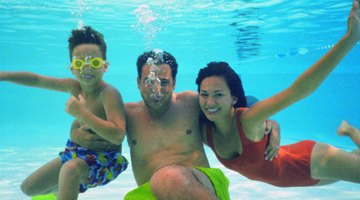
With use, your swimming pool water gains saliva, sweat, dust, algae and any number of dead organic matter sources. Dangerous bacteria and other microorganisms as well as chemicals and various residues can cloud the water, making it unappealing for swimming. Even worse, dirty water can make you sick. To clear up your water and ensure it's sanitary, you sometimes need to super-chlorinate it -- another word for a shock treatment -- to literally burn away the contaminants. Chlorine shock products are widely available, but you may choose a nonchlorine shock if you're sensitive to the chlorine.
Step 1
Uncover the pool completely, and take everything out. Remove any rafts, pool balls and all accessories from the water. Begin near sundown, because the sun and the heat burn off chlorine; shocking the pool overnight conserves the chlorine instead.
Step 2
Clean the pool to remove floating leaves and debris on the pool floor. Because chlorine attacks biological contaminants, excess matter will waste some of the shock.
Step 3
Adjust the swimming pool water's pH as needed. Use a test kit to determine the pH level. Pool water pH tends to rise with use, but at higher levels, chlorine doesn't work as well. Lower the pH to 7.2 to 7.4 with either muriatic acid -- which requires significantly greater amounts -- or sodium bisulphate, which is considered the safer choice. Following the product instructions, add the required amount to a bucket of water, and then walk around the pool slowly to add the mixture. Wait as directed before retesting the pH. Repeat as necessary until the results read the proper level.
Step 4
Fill the bucket about 2/3 of the way with water. Add the amount of shock recommended by the product manufacturer according to the number of gallons of pool water that must be treated. Calcium hypochlorite products, for instance, often require 1 pound per 10,000 gallons of water. A 10-foot-round and 34-inch deep pool may only hold about 3,500 gallons. Other shock products vary in amounts and may not require dissolving in water first. Read the product instructions for best results.
Step 5
Turn on the pool pump or ensure it is still running. Next, slowly broadcast the shock mixture, walking around the pool and slowly but carefully pouring it into the water. Add more on the deeper end, if there is one.
Step 6
Scrub down the pool sides with a broom, mop or pool brush. This will loosen any contaminants, helping the shock work better. Allow the shock to work for several hours, or as directed by the manufacturer.
Warning
Don't swim in the pool until the chlorine levels return to an ideal level of between 1 and 3 ppm.
Things You Will Need
- Chlorinator
- Water test kit
- Bucket
- Pool cleaning tools
References
Writer Bio
Karie Fay earned a Bachelor of Science in psychology with a minor in law from the University of Arkansas at Monticello. After growing up in construction and with more than 30 years in the field, she believes a girl can swing a hammer with the best of them. She enjoys "green" or innovative solutions and unusual construction.
Photo Credits
- Stockbyte/Stockbyte/Getty Images
- Stockbyte/Stockbyte/Getty Images
More Articles

