Every atomic nucleus, except hydrogen, contains both protons and neutrons. Nuclei are too small to see, even with a microscope, and the nucleons (which is the generic term for protons and neutrons) are even smaller. That lets out counting the number of neutrons, yet scientists still know how many are in the nuclei of every isotope of every element. How do they know? They use techniques such as mass spectrometry to measure the total mass of the atoms of a particular element. Once they know the total mass, the rest is easy.
The total mass of an atom is the sum of all its protons, neutrons and electrons, but electrons are so light that, for all practical purposes, they don't matter. That means that the mass of an element is the sum of the masses of its nucleons. The number of protons is the same for every atom of a certain element, and protons and neutrons have the same mass, so all you have to do is subtract the number of protons from the atomic mass, measured in atomic mass units (amu), and you're left with the number of neutrons.
TL;DR (Too Long; Didn't Read)
TL;DR (Too Long; Didn't Read)
The atomic mass equals the number of protons plus the number of neutrons, so you find the number of neutrons by subtracting the number of protons (i.e. the atomic number) from the atomic mass (in atomic mass units). Round the atomic mass to the nearest whole number to find the number of neutrons in the most common isotope.
Use the Periodic Table
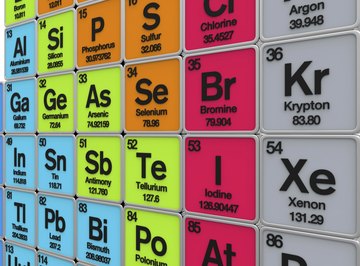
The periodic table lists all the elements by increasing number of protons, so the place that an element occupies in the table automatically tells you how many protons are in its nucleus. This is the atomic number of the element, and it's displayed right under the symbol for the element. Next to it is another number, which is the atomic mass. This number is always bigger than the atomic number it and often contains a fraction, because it's an average of the atomic masses of all the naturally occurring isotopes of that element. You can use it to determine the average number of protons in the nucleus of that element.
The procedure couldn't be simpler. Round the atomic mass to the nearest whole number, then subtract the atomic number of the element from it. The difference equals the number of neutrons.
Example
1. What is the number of neutrons, on average, in the uranium nucleus?
Uranium is the 92nd element in the periodic table, so its atomic number 92 and it has 92 protons in its nucleus. The periodic table lists the atomic mass as 238.039 amu. Round the atomic mass to 238, subtract the atomic number, and you're left with 146 neutrons. Uranium has a large number of neutrons relative to the number of protons, which is why all of its isotopes are radioactive.
The Number of Neutrons in an Isotope
The number of neutrons in the nucleus of a particular element can vary, and each version of the element with its characteristic number of neutrons is known as an isotope. All but 20 elements have more than one isotope, and some have many. Tin (Sn) tops the list with ten isotopes followed by xenon (Xe) with nine.
Each isotope of an element consists of a whole number of protons and neutrons, so its atomic mass is the simple sum of those nucleons. The atomic mass for an isotope is never fractional. Scientists have two ways to denote an isotope. Taking an isotope of carbon as an example, you can write it as C-14 or 14C. The number is the atomic mass. Subtract the atomic number of the element from the atomic mass of the isotope, and the result is the number of neutrons in the nucleus of that isotope.
In the case of C-14, the atomic number of carbon is 6, so there must be 8 neutrons in the nucleus. That's two more than the more common, balanced isotope, C-12. The extra mass makes C-14 radioactive.
References
About the Author
Chris Deziel holds a Bachelor's degree in physics and a Master's degree in Humanities, He has taught science, math and English at the university level, both in his native Canada and in Japan. He began writing online in 2010, offering information in scientific, cultural and practical topics. His writing covers science, math and home improvement and design, as well as religion and the oriental healing arts.
Photo Credits
Nerthuz/iStock/Getty Images