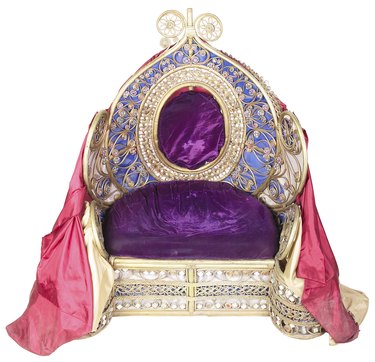
How to Make a Throne Back Wicker Chair

Wicker chairs are elegant and long-lasting pieces of furniture that can add an old-fashioned touch to a living room or patio. They require a lot of time to make, but the rewards may well be worth it. Does this Spark an idea?

Things You'll Need

  • Wicking material
  • Two 5-foot 8-inch lengths of rattan (for legs)
  • Rattan pole (for chair back)
  • Tape measure
  • Wrench or clamp
  • Drill
  • 4-inch wood screws
  • 3-inch wood screws
  • Hammer
  • Finishing nails
  • Paint, sealant or stain
  • Industrial scissors
  • Wax
  • Paint brush
Show More

Instructions

  1. Prepare the Throne Back Wicker Chair Materials

    • 1

      Select the wicking material. Rattan is usually the material most craftspeople choose when making wicker chairs, as it is one of the strongest types of wood that is still pliable. Other types of material exist, however, including reed, bamboo and willow.

    • 2

      Decide on the shape of the wicking material. Round reeds are the most popular. However, oval and flat materials also exist. For your first wicker chair, choose a basic type of wicking material, such as Round Reed #3, available at Jo-Ann hobby stores (see Resources below).

    • 3

      Select the material for the frame of your throne back wicker chair. Originally, 2-inch-thick branches of rattan, willow, reed or bamboo were used. Currently, other options exist, such as plastic and steel, which may last longer and are easier to obtain.

    • 4

      Immerse the rattan thread in water and let it sit until the material is flexible. The amount of time needed to soak the rattan depends on the thickness of the material, but keep in mind that at least 2 hours will be needed. Sometimes up to 12 hours will be required.

    • 5

      Soak the 2-inch-diameter rattan frame pieces for 2 hours to make them flexible. Immerse the rattan and keep it out of the sunlight.

    Assemble the Legs

    • 6

      Select two 5-foot 8-inch lengths of the 2-inch-diameter rattan sections. These will make the legs of the throne back wicker chair.

    • 7

      Use a tape measure to mark off 2 feet at each end of the rattan sections, then mark off at least 1 inch on either side of the first mark.

    • 8

      Bend the rattan, using your hands, at the marks made on each end of the sections. Try to make the bends as tight as possible, and keep the bends within the 2 inches specified. If you need more force, use a pipe wrench (with thick cloth inserted between the rattan and the wrench's jaws to avoid leaving marks on the wood).

    • 9

      Use a stationary clamp, such as one found on a workbench, if you need more force. Keep the jaws of the clamp covered in a thick cloth, then close it tightly around the section of rattan. Push or pull on the section until it bends into the desired shape.

    • 10

      Repeat the procedure with the second section of rattan.

    • 11

      Let the rattan legs dry.

    Assemble the Seat

    • 12

      Make a square seat for the throne back wicker chair with a piece of rattan measuring 82 inches (6 feet 10 inches). Mark off four sections that are 20 inches each, and mark off at least 1 inch on either side of the dividing marks. A 2-inch section should be left over.

    • 13

      Bend the rattan using your hands. Again, keep the bends within the 2-inch limit created when you divided the section, and use the pipe wrench or stationary clamp for added torque.

    • 14

      Align the start of the rattan pole with the 2-inch section left over. Then take a drill with an 11/32-inch drill bit attached and drill exactly halfway down the 2-inch section. Do not drill into the face of the rattan pole.

    • 15

      Use the same drill bit to drill into the face of the rattan pole that presses against the 2-inch section. Make sure the hole is exactly in the center.

    • 16

      Take a 4-inch wood screw and screw it through the 2-inch section of the rattan pole and into the face of the rattan pole's opposite end. Let the seat frame dry.

    • 17

      Mark the thickest point of the rattan pole on the left and right side of the seat frame.

    Complete the Frame of the Throne Back Wicker Chair

    • 18

      Make the chair back using a rattan pole that is 5 feet 8 inches in length. Mark off two 24-inch sections at each end of the pole, and gradually bend the rattan pole using your hands until the pole is U-shaped.

    • 19

      Take one of the legs for the throne back wicker chair and locate its center. Make two marks at either end of the central section of the legs to drill in screws, then measure the distance between the two marks and make two more marks. Make sure all the marks are equidistant from each other.

    • 20

      Use an 11/32-inch drill bit at each mark. Drill through the rattan pole at its thickest point.

    • 21

      Repeat the process on the other leg.

    • 22

      Drill 3-inch wood screws into all the leg holes until the screws are just poking through the other side. Then take one of the legs and press the seat frame against it. Hold the seat frame with one hand and use an electric screwdriver to screw the two pieces of wood together, making sure the screw does not go in at an angle.

    • 23

      Screw the other chair leg onto the seat frame.

    • 24

      Mark the center of both faces of the rattan pole that will be the chair back. Use the 11/32-inch drill bit to drill two holes into the marks.

    • 25

      Measure where the seat back will touch the seat frame. Drill a hole with the 11/32-inch drill bit on both sides, then screw the seat back onto the seat frame.

    Begin Weaving the Wicker Chair

    • 26

      Stretch at least 20 pieces of rattan across the space of the throne back wicker chair's seat frame. Use one long piece of thread, looping it around the sides of the throne back wicker chair's seat frame, and nail the loops to the frame with small finishing nails to keep them from sliding.

    • 27

      Knot a piece of rattan to one of the threads stretched across the seat frame, using a bowline knot. Then weave the rattan perpendicular to the pieces that are stretched out, going over and under until the other side of the seat is reached. Loop the thread of rattan around the other side of the seat frame and repeat the process, making sure the second line is pressed tight against the first. Gaps can weaken the structural integrity of the throne back wicker chair's seat and back.

    • 28

      Add a new rattan thread to the seat frame by measuring the old one so that the end of it lies on top of the frame, and then nail the end of the thread to the frame with a tiny finishing nail. Use another finishing nail to anchor the new thread of rattan right next to the old one, and then continue weaving.

    • 29

      Nail the rattan thread to the inner part of the seat frame once the seat has been finished.

    • 30

      Nail a piece of rattan to the inside corner of the seat frame using a small finishing nail. Begin to wrap it around the leg of the chair. Make sure the rattan is tightly wound and check that no gaps in the material are showing.

    • 31

      Hammer in another finishing nail to act as a checkpoint for the rattan. In case you make a mistake, the nail will provide a spot where you can begin again.

    • 32

      Splice in another piece of rattan to your first piece if you are unable to complete the leg. Use another finishing nail to hammer in the rattan just before the end of the previous piece to avoid a gap, then continue wrapping.

    • 33

      Finish off the leg by nailing the rattan to the bottom of the leg. Wind the rattan around the leg's bottom to provide thickness, and then use an industrial pair of scissors to cut off the excess rattan. Weaving the rattan into a knot is considered the most aesthetic way to finish the leg. However, hammering in another finishing nail is acceptable for beginners.

    • 34

      Repeat the procedure for the other three wicker chair legs.

    Complete Weaving and Finish the Chair

    • 35

      Stretch 20 to 30 threads of rattan across the throne back of the wicker chair. Make sure the threads are equally spaced. The best way to do this is to use one long thread of rattan, tying it off at both ends, and use finishing nails to make sure the thread stays where it should.

    • 36

      Weave rattan thread across the throne back frame. Thread it through the stretched pieces of rattan. When you get to the other side of the frame, loop the thread around and weave the rattan in the other direction.

    • 37

      Take another piece of rattan thread and wrap it around the seat back frame. Treat this the same way as wrapping the throne back wicker chair's legs, using a finishing nail to attach the rattan thread to the junction of the throne back and the seat frame. Tightly wrap the thread around the rattan pole until the other side is reached. Attach the end of the rattan thread to the other junction between the throne back and the seat frame.

    • 38

      Coat the throne back wicker chair with a thin film of wax. Melt some wax, and then use a paint brush to apply it to the chair, making sure to get in the cracks. Since the wax will dry fast, err on the side of caution and apply too little, rather than too much, on the first coat.

    • 39

      Add paint, sealant or stain instead of the wax if you want to take a more modern approach. Spray paint works best for both protection and color, and it will eliminate any gaps in the paint job. Stain may work, but it tends to flake off if the throne back wicker chair is left outside.

Tips & Warnings

  • Practice making wicker baskets first before graduating to a throne back chair. Fancy antique wicker chairs are the result of weavers putting years of experience into their projects.

Related Searches:

Resources

Comments

  • indochinedecor Nov 04, 2008
    Fine Contemporary Furniture, Flooring & Interiors - Manufacturer Our customers include home builders, hotels, resorts, restaurants, furniture wholesalers, importers, retailers, architects, interior designers and individual customers. We manufacture contemporary furniture, both indoors and outdoors, flooring and decor items primarily in reclaimed old teak, natural and synthetic rattan/wicker, water hyacinth, bamboo, leather, stainless steel, aluminum and various metals. We can custom manufacture to our customersÂ’ designs and specifications. Sample sets can be produced at short notice. Due to the availability of quality raw materials and skilled workmanship, our prices are consistently lower than our competitors, comparing product material, quality and finish. No compromise in workmanship and quality of materials, ensuring life long durability that will always come with
  • jjreese Oct 05, 2008
    As a visual learner, I'd give anything for pictures.
  • jjreese Oct 05, 2008
    As a visual learner, I'd give anything for pictures.

You May Also Like

Related Ads

Featured