How to Successfully Grow Tomato Plants

By wendyr

Rate: (5 Ratings)

Here are some useful tips for getting larger, healthier looking, and more abundant tomatoes out your garden. Plus some advice about what to look out for to prevent disease and pests from taking over your tomato plants.

Instructions

Difficulty: Moderate

Things You’ll Need:

  • Tomato seeds or plants
  • Tomato cage or stakes to support the plant as it grows
  • Collar to keep cutworms away

Step1
Whether you are growing your tomatoes from seed or buying tomato seedlings at a local garden store, you'll be able to grow healthier tomato plants with more tomatoes if you follow these tips. Tomato plants can be planted in many ways: in the ground in your vegetable garden, in raised bed, or in a container. These steps apply to all methods.
Step2
Contrary to popular belief, the better tomato plants to purchase at the garden store are the smaller plants that are not budding yet. The taller plants that begin blooming in their tiny pots are struggling and will not develop as much fruit. So when you are out shopping around for tomato plants, buy the smaller ones. Try a few different kinds of plants such as Beefsteak, Roma, Sweet 100's, or Brandywine tomato plants.
Step3
Before transplanting your seedlings into the ground or container, mix a cup of fertilizer in the soil. Tomato plants prefer organic matter in the soil, so add some compost as well. The pH of the soil should be between 5.8 and 7.0. Correct the pH in the soil now, if that needs to be done.
Blend it into the top eight inches of the soil.
Step4
You may cover the top of the soil with red or black plastic to warm up the soil. This enables the plant to grow faster and to produce ripe tomatoes earlier. Simply cut holes in the plastic where you plan to plant your tomato plants.
Step5
Consider planting your tomatoes near good companion plants and away from bad companion plants. Good companions include basil, beans, carrots, chives, cucumbers, garlic, nasturtiums, parsley, and marigolds. Some of these companion plants such as marigolds, chives, and nasturtiums help repel bad bugs. Bad companion plants are pole beans, dill, and potatoes. So avoid planting your tomato plants next to those plants.
Step6
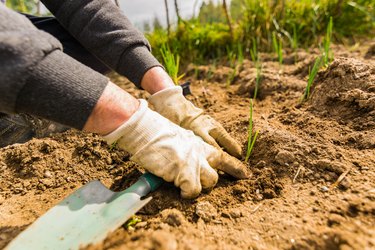
After danger of frost has past, and after you have hardened off your tomato plant, dig a deep hole and plant the tomato plant as deep as you can so that you only have the top four inches of the plant above the soil line. Remove the leaves below the soil line. Then fill in the dirt around the plant and water it well every day for the first week.
Separate your tomato plants by about 15-20 inches apart.
Or, if you prefer to plant your tomato plants earlier (before your frost-free date), you will need to protect your tomato plants. You can cover the seedlings with a home-made cloche such as a milk jug with the bottom cut out, or a soda bottle with the bottom cut out. Leave the caps off the cloches so there is some air ventilation for the plant.
Step7
Tomato Plant With Collar Place a protective collar around the bottom of each tomato plant as you are planting it in the ground. The collar should be an inch or two below and above ground to stop cutworms from chewing your plant off at the base. A collar can be made from a plastic cup with the bottom cut out, a tin can with both ends cut off, or anything like that.
Step8
Tomato Hornworm Moth A floating row cover is useful for two reasons. First, it keeps the plant a little warmer than the outside air, plus it helps to keep the pests away from your tomato plants. The floating row cover can be used day and night while the plants are still developing. When the plants begin to blossom, the bees need access to the plants to pollinate them. At this point, the row covers should not be covering the plants anymore.
Step9
As your tomato plants begin to grow, you'll need to support them with tomato cages, stakes, or by tying them to some kind of support poles.
Step10
Check on your tomato plants once or twice each week. Check to see if they need more water, that they are growing well, that the leaves are a nice green color, that the leaves are not eaten and are not spotted. The plants should be watered on the ground, taking care not to splash water on the leaves too much. Fertilize your tomato plants every week or two, depending upon how they are growing.
Step11
If you have indeterminate tomato plants, they should be pruned frequently. The bottom leaves should be removed to keep fungus from getting on the leaves from water splashing back up on them. About 1/4 to 1/3 of the lower part of the plants should have their branches removed. In addition, pinch out all suckers on the plant. The suckers are the parts of the plant between the main stem and the main branches where new growth begins. That new growth takes energy away from the plant that could be better used to develop tomatoes.
Step12
Fungus Spots on Leaves Constantly check for signs of fungus, those black or brown spots that appear on the plants. Dispose of leaves with fungus so it doesn't spread to the rest of your plants. You may apply an organic fungicide or sulfur to help prevent this if you frequently get this problem.
Step13
Tomato Hornworm Constantly check for black or green poops, or munched leaves as this is the classic sign of tomato hornworms. They begin as tiny eggs on the underside of a tomato leaf and they grow into rather large ugly looking fat worms. Then they transform into a rather large moth which is what came to lay the eggs on your tomato plant in the first place. Those floating row covers can help keep those pesky moths away.
Step14
Tomato Hornworm With Parasites The tomato hornworms blend in nicely with the tomato leaves but they can be found if you look hard enough. Dispose of all tomato hornworms that you can find except for those that have been affected by parasitic wasps. The parasitic wasps are beneficial and will eventually kill their host.
Step15
Water your tomato plants *consistently*. Too much water will cause your ripening tomatoes to get cracks in them. I try to pick as many ripe tomatoes as I can before a heavy rain storm because I usually find that afterwards I have cracked tomatoes.
Step16
Pay attention to your tomato plants. There are early signs of pests and diseases that you can catch and treat if found early enough. If you see something that you are not sure of, search on google with a description of what you noticed and you'll likely find out what it is and how to treat it. Posting to a gardening newsgroup is also an option to find out what is going on with your tomato plants. Or, you can view photos of common tomato plant problems at http://aggie-horticulture.tamu.edu/tomatoproblemsolver/index.html to see if you can find out what your particular problem is and how to fix it.
Step17
It can take about 25 days for a tomato to grow to full size from the day of pollination, plus another 25 days for it to ripen. The exact number of days does vary depending upon the variety of tomato plants you grow. The point is that it takes tomatoes a long time to ripen, so be patient and enjoy your delicious ripe tomatoes.

Comments

| View All Comments
Flag This Comment

on 7/11/2008 I was wondering what was causing my ripening tomatoes to crack. Thanks to your article, now I know. You provided lots of details. Thanks!

wendyr said

Flag This Comment

on 5/15/2008 REDMIKE, You could try some of these options:
1. Only water in the morning, not late afternoon/evening. Also only do ground watering, don't do overhead watering.
2. Apply neem oil spray on the leaves weekly (works better as a preventative, so start before you have this problem). Be careful because you don't want to use neem oil when the tomatoes are flowering because a direct application to any bees could kill them. Follow the directions on the bottle.
3. Apply an organic fungicide. You can find one at gardensalive.com or other places. Follow instructions on the bag to apply it and use when needed.
4. I think you're already doing this. Remove infected leaves.
5. If you haven't planted them yet, you could try to space your tomato plants a little further apart. This lets the plant leaves dry faster and makes it more difficult to spread the fungus from one plant to another.

REDMIKE said

Flag This Comment

on 5/12/2008 FUNGUS OR BROWN SPOTS SHOW UP NO MATTER WHAT I DO,MY SETS FROM THE GARDEN STORE DEVELOPED SPOTS AFTER THEY HAD GROWN A FEW INCHES AND AS ALWAYS THE LOWER LEAVES TURN BROWN AS TIME GOES BY. I DO TRIM THEM OFF AS NEEDED BUT SOME TIMES I GET SUNBLISTERS ON THE TOMATOES FROM DOING THIS. I ALWAYS HAVE LOTS OF FRUIT SO IT DOESN'T SEEM TO REDUCE THE YELD BUT IM OPEN FOR HELP ON HOW TO STOP THIS FROM HAPPENING.
MIKE.

CBartok said

Flag This Comment

on 5/4/2008 Good article and very well presented. You didn't mention pruning. I like to prune First set for stronger and more abundant yield.

showpup said

Flag This Comment

on 5/4/2008 GREAT article. Lots of fantastic information that will really help me this season. 5 stars!

View All

Post a Comment

POST A COMMENT

Request a New How-To Article

Looking for more How To information? Chances are there’s an eHow member who knows how to do what you’re looking to do. Submit an article request now!

eHow Article:  How to Successfully Grow Tomato Plants

eHow Member: wendyr

wendyr

Authority Authority | 3784 Points

Category: Home & Garden

Articles: See my other articles

Related Ads

Home & Garden

Willi
Meet Willi Galloway eHow’s Home & Garden Expert.