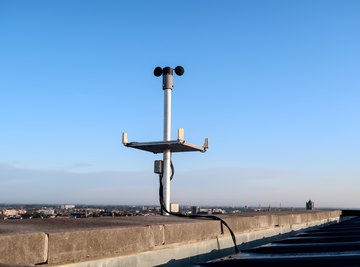

Though something of an awkward word, anemometer refers to a simple but surprisingly versatile instrument, one found in the most basic weather stations the world over. The translation from Greek is straightforward: "anem-" being the root of "wind" and "meter" meaning (in general terms, not as a quantity) "measure."
When you think of the word "weather" itself, unless you live in outer space, one of the first words or sensory images that comes to mind is almost surely wind, a phenomenon that can cause catastrophic damage yet remains a cherished part of almost everyone's life experience, if reams of poetry and literature exploring the reach of the phenomenon are to be trusted.
For reasons of safety, recreational planning and plain curiosity, knowing the speed of the weather at any time – or at least the direction in which it's blowing if for some reason you can't get outside to detect this with your own senses – in your area, or in a spot you intend to travel to soon, is useful information indeed. Many different types of anemometer are available for this purpose, some of them relying on especially clever methods to indirectly measure wind speed.
Where Does Wind Come From?
A young child told that the Earth spins around at 1,000 miles an hour at its equator, and at around 800 miles an hour at 40 degrees latitude (about where most of the U.S. population is centered), might assume that wind comes from the simple whipping around of an object at seemingly impossible speeds. While this makes intuitive sense, the real picture is vastly more complex but also offers valuable teaching points about weather phenomena related to, but independent of, wind itself.
The sun is the ultimate source of energy for a great many processes on Earth, and wind is no exception. Wind results mainly from different parts of Earth's surface absorbing different amounts of heat from the sun. This energy is expressed as wind through convection, the transfer of heat via movement in a fluid. Hotter air tends to rise while cooler air sinks, setting up continually rotating exchanges of air between adjacent regions of air with different temperatures.
Wind circulates around the globe in well-known "streams" that are like famous rivers of air: jet streams, trade winds, polar jets. Winds are categorized based on their specific sources of origin as geostrophic winds, thermal winds or gradient winds.
The Physics of Wind Power
Air has mass, so it is possible to calculate the kinetic energy of moving air just like any other object. The equation for kinetic energy is KE = (1/2)mv2 where v = velocity. (Wind velocity is rarely constant for long, so wind speed is usually averaged over short time periods in order to generate meaningful data.)
The mass of a given volume of air is its density times its volume, or ρV. But with wind power, or energy per unit time, the variable of interest is "wind mass flux," or how much air flows across the cross-sectional area A of the turbine (often a circle). The equation for wind power turns out to be
meaning that power increases with the cube of wind speed. That means a wind of 30 MPH provides 103 = a thousand times as much power as a wind of 10 MPH!
- As for anemometer units, wind speed is usually in miles per hour (mi/hr, or in everyday parlance, MPH) or kilometers per hour, though SI units would be meters per second (m/s). If you're interested in doing a quick conversion from MPH to m/s, divide by about two and a quarter:
Types of an Anemometer
You already know what an anemometer "is." But at the granular level, what sort of devices do people measure the wind speed?
- Cups and propellers: This is the most widely used type of anemometer, and easy to make. Problems can occur with low wind speeds and with freezing rain.
- Pitot tube: These are used on aircraft and in "wind tunnels" in labs.
- Drag cylinder or sphere: These are not common, but bear mentioning.
- Dissipation anemometer: These are especially rugged versions.
- Speed-of-sound anemometer: These are expensive, and not for household use, but are fast and reliable.
Sometimes, wind direction is the chief concern, with speed less important. With this in mind, airports have wind socks that tell a lot about soon-to-occur weather. For example, a wind out of the northwest (a NW wind) usually means cooler, drier weather, whereas a SE wind often brings warmer, more humid air.
How Anemometers Work
The cup-and-propeller style of anemometer is, as noted, the most common type; fortuitously, its operation is easy to explain. As the wind spins the arm of the propeller around, the cups "catching" the wind spin through a circle of known radius (2 times π times the length of the propeller arm, or the circumference) in a known time, as the spins of the central rod are counted. Total distance (revolutions times circumference) divided by time is wind speed.
Other kinds of anemometers determine wind speed in more involved ways. A hot-wire anemometer uses the fact that when air flows over an object heated to a temperature warmer than the air, the object will be cooled as heat is removed via convection.
In a hot-wire anemometer, a metal wire that has been electrically warmed is exposed to the wind, while the power is increased or decreased to keep the temperature at the wire tip constant. Thus the higher the wind speed, the more power that's needed to maintain thermal equilibrium.
Measuring air pressure – which itself is measured by an instrument called a barometer – can also be used to calculate wind speed. A tube anemometer, for example, measures the air pressure inside a glass tube that is open only at one end. Wind speed can be calculated from the difference in pressure between the inside of the tube and the exterior.
- If you'd like to try your hand at making your own anemometer from ordinary items, an example of how to do is provided in the Resources.
Other Anemometer Uses: Sports
In running events in outdoor international track competitions, where runners move in one net direction, the wind can aid (or hinder) competitors and produce superior times. For this reason, an anemometer is placed at trackside during these events. The maximum allowable net wind speed in the direction of the runners for the setting of new records is 2.0 m/s, so if the wind gauge reads above this value at any time during the race, the mark is ineligible for record purposes.
From a previous section, you know that wind speed in miles per hour (MPH) is a little more than double its value in m/s. Thus a wind of 5 MPH, which would be considered quite modest by everyday standard, is sufficient to provide enough of a boost to render a mark outside the realm of "true" human achievement. When finishing just 0.01 seconds faster than anyone has ever run before in a race lasting less 10 seconds, every factor is critical. Now imagine track without modern timing equipment, let alone anemometers!
References
About the Author
Kevin Beck holds a bachelor's degree in physics with minors in math and chemistry from the University of Vermont. Formerly with ScienceBlogs.com and the editor of "Run Strong," he has written for Runner's World, Men's Fitness, Competitor, and a variety of other publications. More about Kevin and links to his professional work can be found at www.kemibe.com.