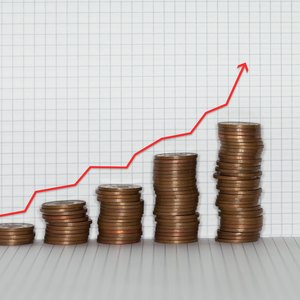


You may have heard that things “cost more than they used to.” Maybe you were the person who said it. It is true that the price of most goods and services do increase over time due to inflation. So, if you are planning to purchase an item several years in the future, you cannot plan using today’s price. Instead, you should plan to pay a higher price related to expected inflation rates.
Tips
You can calculate the future cost of goods by using the Consumer Price Index as a measure for gauging inflationary forces over the short term.
Finding the Right Inflation Rate
The Consumer Price Index (CPI) is the most commonly used index for tracking inflation. The index measures changes in prices across a variety of consumption goods in categories such as food and beverage, housing, apparel, transportation, medical care, recreation, education and communication. It is important to note that the CPI or reported inflation rate is a composite rate that represents changes in a basket of consumption goods. The inflation rate for a particular item in the basket may vary drastically from the overall inflation rate due to supply and demand conditions for that individual good. For example, the overall composite inflation rate may be 1 percent, but oil and gas may actually be 10 percent lower while housing related expenses are 4 percent higher.
Historical inflation rates are useful for determining general trends over long periods of time. Historical inflation rates, however, will not necessarily provide an accurate estimate of future inflation rates -- unless they are not expected to change. It is better to find estimates of expected future inflation rates. In addition, you should account for any differences between the expected inflation rate of a particular good from the composite inflation rate.
The Calculation
The general formula for the future price equals the current price times the inflation rate for every year into the future. If you wanted to compute the expected price in two years, you could use the formula:
Future price = Current price x (1 + Inflation rate year 1) x (1 + Inflation rate year 2)
Example: You plan to buy a new car in two years that costs $30,000 today. Estimated inflation rates are 0.1 percent (0.001) for year 1 and 1.49 percent (0.0149) for year 2. Make the following calculation:
- Future price = $30,000 x (1 + 0.001) x (1 + 0.0149)
- Future price = $30,000 x 1.001 x 1.0149
- Future price = $30,477.45
References
- Buy Upside: Save Enough to Account for Inflation
- Bureau of Labor Statistics: Consumer Price Index
- US Inflation Calculator: Current Inflation Rates
- Congressional Research Service. "Introduction to U.S. Economy: Inflation," Page 1. Accessed Sept. 17, 2020.
- BLS. "CPI Inflation Calculator." Accessed Sept. 17, 2020.
- BLS. "Consumer Price Index – July 2020," Page 4. Accessed Sept. 17, 2020.
- BLS. "Consumer Price Index – July 2019," Page 4. Accessed Sept. 17, 2020.
- FDIC. "An Update on Emerging Issues in Banking," Page 1. Accessed Sept. 17, 2020.
Writer Bio
Kimberly Goodwin has a Ph.D. in finance from the University of Alabama and is an associate professor of finance and the Parham Bridges Chair of Real Estate at the University of Southern Mississippi. She publishes in top real estate journals as well as on her blog, Your Finance Professor. Goodwin is also the managing editor of the Journal of Housing Research.