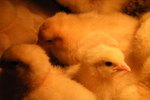
Raising chickens is the latest trend for suburban and city folk to take up. Because of the poor economy, some Americans have turned to raising their own food, including raising chickens. The new urban farmers feel a sense of security raising their own birds but many are new to poultry. They may not even understand the different breeds or types of chickens they own. To tell what kind of chicken you have, look at all the characteristics of the bird.
Examine the size of the chicken. Chickens come in generally two size, bantam or standard. Bantam are miniature chickens, one-quarter the size of standard chickens, which produce eggs that are one-quarter to one-half the size of regular chickens, which weigh about 5 1/2 pounds. Some breeds come in both sizes while others come in either bantam or standard.
Look at the feather colors of the chicken. Most chickens have a base color to their feathers. Light brown or tan colored chickens could be Buff Orpingtons, which are from England. They are bred for meat and good egg production. Other chickens have different colors on the head than on the body, like Brahma, which have white bodies and breasts with black and white heads and tails. Some chickens have legs feathers, such as the Silkie, and others do not.
Observe the egg color from the hens. Many different types of chickens lay eggs in a variety of colors. Ameraucanas are known for their greenish-blue eggs and Japanese Bantams have pale beige to cream colored eggs. Also, the egg size will give you information about the chicken breed. Small eggs are from smaller hens, such as Chinese Silkies.
Look at the comb of the chicken. The comb is the fleshy growth at the top of the chicken's head. Both males and females have combs, but the male comb is larger. This helps distinguish the sex of the chicken. Also, different breeds have one of eight comb types. A pea comb is a small comb with three ridges and an Aseel have pea combs. Another type is the rose comb that looks flat and round, which Hamburg chickens have. Other types are strawberry, Silkies, single, cushion, buttercup and V-shaped.
Observe the temperament of the chicken. Breeds like Orpingtons and Silkies are known for a gentle temperament, while the Buttercup is known for being flighty, and they avoid human contact. Other behavior traits to determine what kind of chicken you have are aggression and broodiness, which is when a hen refuses to leave her nest of eggs even if it is empty. Some breeds are known to be more broody than others such as the Belgian D'Uccle.
Tips
Listen out for crowing to determine the sex of the chicken. If it crows, it is a rooster. If it lays eggs, it is a hen.
Most reputable breeders will provide information about the type of chick or chicken you are purchasing.
It can be difficult to figure out the breed of a young chick. You must wait until it is about four months old to distinguish its breed traits.
Warnings
Use caution when handling unknown chickens especially around young children.
References
Photo Credits
-
Thinkstock Images/Comstock/Getty Images
Writer Bio
Charong Chow has been writing professionally since 1995. Her work has appeared in magazines such as "Zing" and "Ocean Drive." Chow graduated from the University of Miami with a Bachelor of Arts in philosophy. She also received a Bachelor of Fine Arts from the California Institute of the Arts.