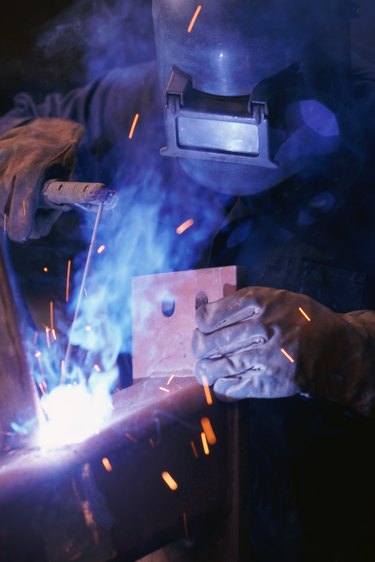
The 7018 arc welding rod is commonly used for general-purpose welding of carbon steel. It is a mild steel rod that is coated with a low-hydrogen, iron-based flux compound that vaporizes to shield the molten weld bead from contamination by air and moisture. This rod has a tensile strength of 70,000 lbs. per square inch, provides medium-penetration welds, can be used in all positions and can be used with either AC or DC welders.
Amperage Rule
Video of the Day
There is no single all-purpose amperage figure for the 7018 welding rod. The correct welding amperage used with this rod depends on the rod diameter. In turn, the rod diameter you use depends on the thickness of the steel you are welding. In general, the 7018 rod is used with currents up to 225 amps. A rule of thumb is to use 30 amps of current per 1/32 inch of rod diameter. That would mean using 90 amps of current on a rod that is 3/32-inch in diameter.
Video of the Day
General Guide
The amperage recommendations for 7018 rods will vary between manufacturers; follow the manufacturer's recommendations for setting your welding current. If you have no manufacturer's recommendation handy, there are some general amperage settings you can try. If using a 7018 rod of 3/32-inch diameter, the amperage should be around 50 amps on 1/16-inch thick steel and around 90 amps for 1/8-inch steel. For a 1/8-inch rod, try starting with 90 amps on 1/8-inch steel and around 140 amps on ¼-inch steel.
Bigger Rods
You can use a 5/32-inch diameter rod at 120 amps on steel ¼ inch thick. Boost your current to 180 amps to weld steel 3/8 inch thick. You can use a 3/16-inch rod at 150 amps to weld 3/8-inch steel. For ½-inch steel, use the 3/16-inch rod at 225 amps. If you have your amperage set too high for the steel you are welding, your arc will undercut the joint and the molten puddle of weld metal will be hard to control. Another clue that you are too hot is if your welding rod glows red hot along its length. If current is too low, you will have trouble forming a molten puddle of weld metal that fuses with the joint.
Keep Dry
If a 7018 rod is damp or moist, you will have trouble welding with it at any amperage. The flux coating on these rods absorbs moisture from the air. The moisture will make the arc spit and pop, and produce a weld that's porous and weak. These rods must be dried in a rod oven at temperatures above 500 degrees Fahrenheit and kept dry in a heated cabinet at 250 degrees until used. Rod ovens are specifically designed for drying and keeping welding rods. Avoid storing 7018 rods in freezers, old refrigerators and other makeshift cabinets. These won't keep moisture at bay.